“Sickening and greedy.”
Those are former health care executive and current millionaire Dave Nixon’s words for Google co-founder Larry Page, who’s leaving California over a proposed new tax.
A member of the Patriotic Millionaires, which apparently pushes for tax hikes on the wealthy, Nixon is disgusted that the world’s second-richest man – with a net worth of $276 billion – doesn’t want to share more than he already is giving away to taxes and charities.
Five percent of his net worth more, to be specific.
That’s what California’s 2026 Billionaire Tax Act seeks: to take a one-time 5% cut out of resident billionaires’ net worth. And while it won’t come to a vote until later on this year, it would apply retroactively to those in state as of January 1.
There’s no guarantee the bill will pass, mind you. It already has considerable opposition from Governor Newsom, whose biggest donors aren’t in favor of it. Even so, out of an abundance of caution, Page ended his 27-year California-living status as of last month.
He moved his family office and various business entities to places like Nevada and Florida, with articles of incorporation filed in Delaware. And he reportedly just spent over $173 million on two Miami mansions.
Page might not be the only Californian rethinking his address.
Florida luxury real estate agents reported a recent uptick in calls from wealthy California residents asking about properties. One of those calls might very well have come from the other half of the Google-founding team, Sergey Brin – currently the third-richest person in the world.
Meanwhile, Peter Thiel announced a new satellite office in Florida on New Year’s Eve… the same day his fellow venture capitalist David Sacks did the same in Texas. Rumor is these were calculated moves to circumvent the Billionaire Tax Act, if it passes.
It appears they’re all waking up to a reality I’ve been recognizing for years – that blue states aren’t what they used to.
American Migration
I’m not trying to be political. But a core focus of ours at Wide Moat Research is commercial real estate (“CRE”) and real estate investment trusts (“REITs”). And the value of these businesses and properties are often at the whim of state and local regulations. That’s why we spend time understanding how much exposure these companies have to high-tax, high-regulation jurisdictions.
And as I’ve been telling readers for years now, a trend is emerging – a new American migration is underway.
Here’s how I described it in a recent report for The Wide Moat Letter (subscribers can access that research here):
We’re seeing Americans flee areas with high costs of living, high taxes, and high regulatory burdens in favor of the sunny South.
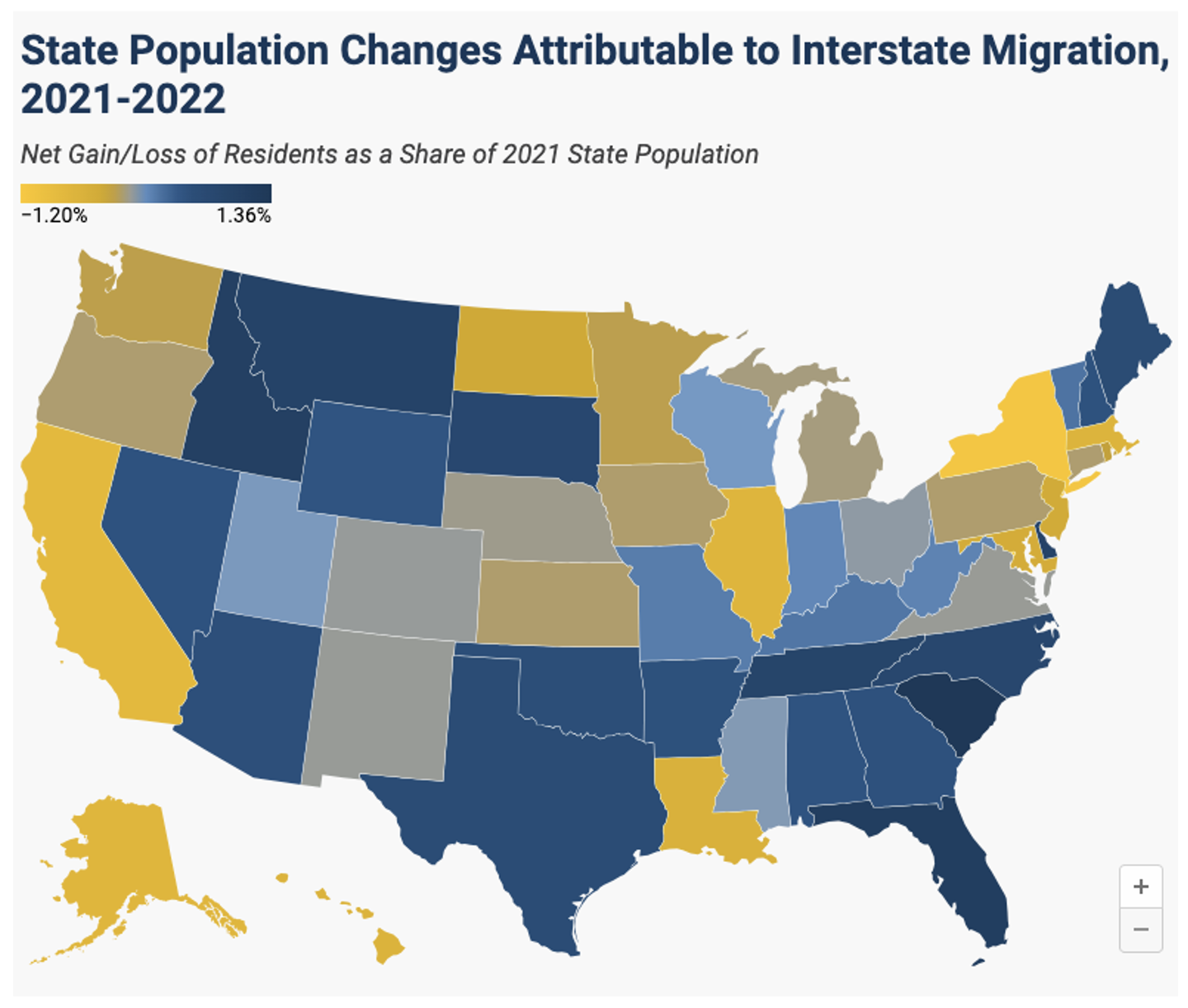
Florida and Texas appear to be the biggest winners of this trend, as made clear by recent 2030 congressional apportionment projections.
[… ]
Researchers at the Brennan Center say that if current migration trends continue, California could lose four congressional seats, New York could lose two, Illinois could lose one, and Pennsylvania could lose one.
“By contrast,” the organization says, “the South has emerged as this decade’s growth engine, adding almost 3.9 million people and accounting for nearly all U.S. population gains since 2020.”
I also shared this chart, which drives the point home:
Source: Tax Foundation
Why the move?
From my same report to Wide Moat Letter readers:
As part of its regular data releases, the U.S. Census publishes the Current Population Survey Annual and Economic Supplement (CPS ASEC). Within that report, researchers ask a simple question: Why are you moving? Sticking with the 2021-2022 timeframe mentioned above, the answers are interesting.
[… ]
What stands out to me is that for both 2021 and 2022, housing and quality of life were top priorities for those who got up and moved. More spacious, more affordable housing, in particular, was the top reason.
So, it’s clear where these disenfranchised blue staters are going… and why.
I’m not the only one who sees this.
To quote the Associated Press, “Americans and immigrants are gravitating toward warmer climates, cheaper housing, lower taxes, and plentiful jobs.” All of which are much more attainable under red-state management.
Businesses and individuals alike prefer to be where they can thrive. And it’s harder to thrive when the government keeps taking more of your money – especially to throw at problems that never end up getting fixed. In many cases, they just keep getting worse.
People like Dave Nixon can call that “selfish” all they want. But human beings always respond to incentives. And the incentive of a wealth tax is simple – go somewhere else.
Follow the Money Down the Red-State Road
I’m in New York City today participating in the opening bell ceremonies for a new exchange-traded fund (“ETF”): the Truth Social Red State REIT ETF (TSRS).
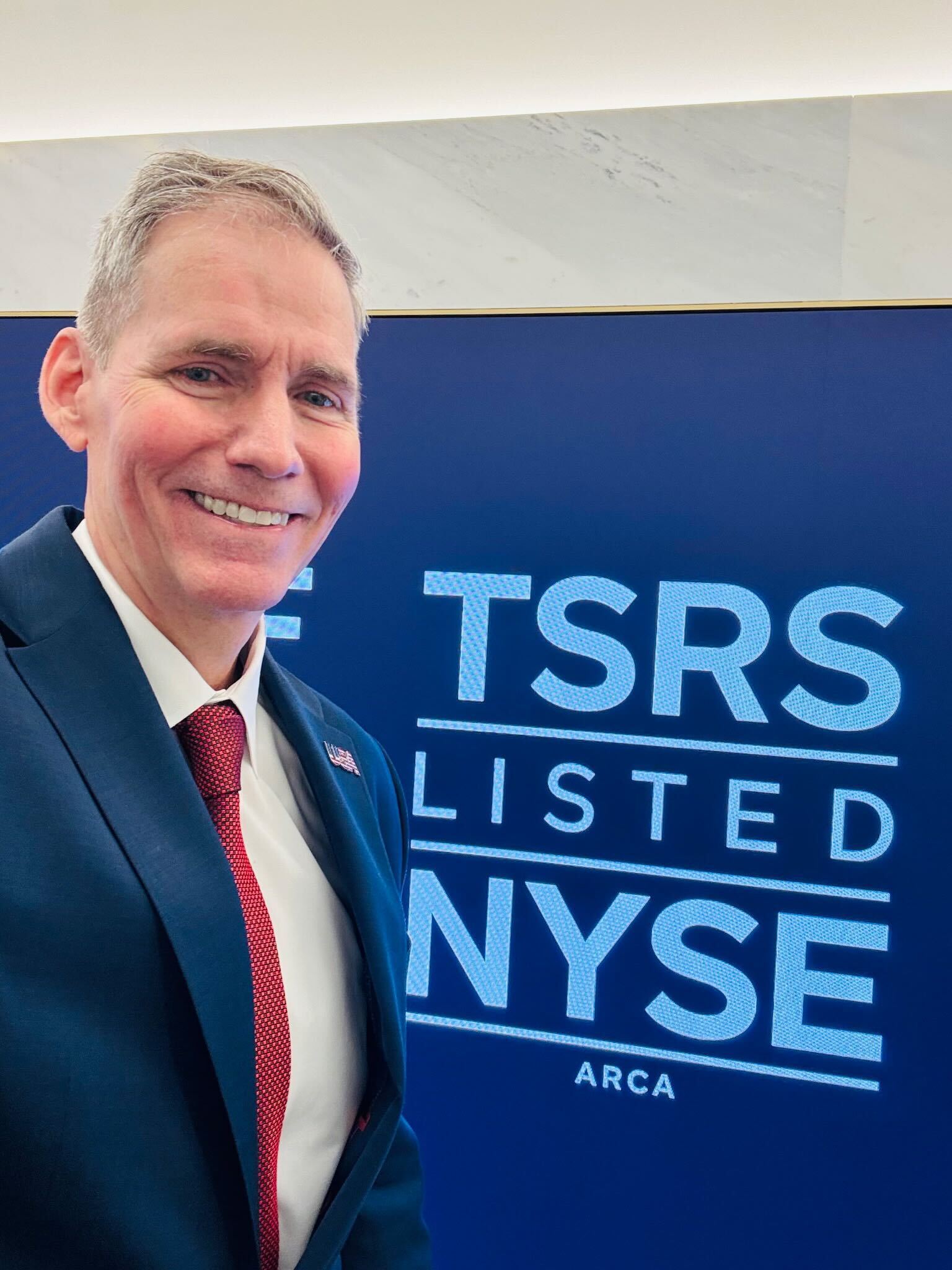
I don’t manage the ETF, but it follows an index I helped design: the MarketVector™ – iREIT® Red State REITs Index.
According to the ETF’s prospectus:
The MarketVectorTM – iREIT® Red State REITs Index (the “underlying index”) is designed to track the performance of real estate investment trusts (“REITs”) that earn the majority of their revenues or income from U.S. states that voted for a Republican presidential candidate in two of the last three elections. To be eligible for inclusion in the underlying index, securities must be organized as REITs and have revenue or income attribution thresholds from state-level political outcomes. To qualify for initial inclusion, a company must have at least 65% of its revenues or net operating income from, or 65% of its properties in, states that voted for or carried a Republican presidential candidate in two of the last three presidential elections.
As of January 14, the top five constituents in the passively managed Red State ETF are all net-lease REITs:
-
National Retail Properties (NNN)
-
Broadstone Net Lease (BNL)
-
VICI Properties (VICI)
-
Realty Income (O)
-
Four Corners Property Trust (FCPT)
Other top 10 holdings include Lamar Advertising (LAMR) – which just so happens to be backed by Berkshire Hathaway (BRK-A)(BRK-B) – and MidAmerica Apartment Communities (MAA), a Nashville-based apartment REIT. Plus, Red State includes exposure to health care, farming, single-family rentals (a hot topic I wrote about earlier this week), manufactured housing (more on that here), and industrial space.
As long as blue states keep asking residents to give more… and as long as red states keep their taxes low and their regulations light, I think these businesses have a bright future. I look forward to seeing the ETF in action throughout 2026.
Regards,
Brad Thomas
Editor, Wide Moat Daily
|