“How do you know when a stock is a trade and when it’s an investment?”
That’s what one bright-eyed finance student asked me while I was speaking at Penn State University yesterday.
As longtime readers know, I guest lecture on real estate investments from time to time. In addition to Penn State, I’ve been invited to Georgetown, New York University, the University of North Carolina, Cornell, and Clemson.
It was a great question, but I had my answer ready: “Look at the track.”
I said that a “trade” is best compared with a frantic 100-meter dash. It’s a short-term act of high adrenaline on a perfectly flat surface that still ends with the runner gasping for air.
A marathon, however, requires a more measured and disciplined pace. Knowing they’re in it for hours on end, marathon runners aim to save their breath so they can keep moving forward regardless of the terrain.
So if you’re already seeing your finish line as you click “buy” on a stock – or if you’re in it for fast-and-furious profits – you’re trading. And while we’re not averse to the occasional trade, most people are better off running marathons alongside a Dividend King or two (or more).
These elite publicly traded companies have upped their annual dividend payouts for at least 50 consecutive years. This isn’t something a company achieves by accident. It requires a great degree of intentionality that aims for – and achieves – three ultimate outcomes:
-
Investment-Grade Credit Ratings: Businesses that are trusted by ratings agencies (S&P, Moody’s, and Fitch) sport investment-grade credit ratings (BBB- and up for S&P and Fitch, and Baa3 or better for Moody’s). Such credit ratings are a license for companies to borrow at lower interest rates even when credit markets tighten up.
-
Earnings Consistency: Dividend Kings or true contenders for that crown will show decades of consistent, upward trajectory in their earnings per share (“EPS”). Over time, this is what drives growth in their payouts to shareholders, too.
-
Sustainable Payout Ratios: High-quality companies feature payouts that don’t break the bank. There’s always money left over for both growth opportunities and inevitable downturns alike.
Now, that’s an investment.
The Only REIT King: Federal Realty Investment Trust
To drive the point home, I shared the one real estate investment trust (“REIT”) that can lay claim to the Dividend King title so far: Federal Realty Investment Trust (FRT).
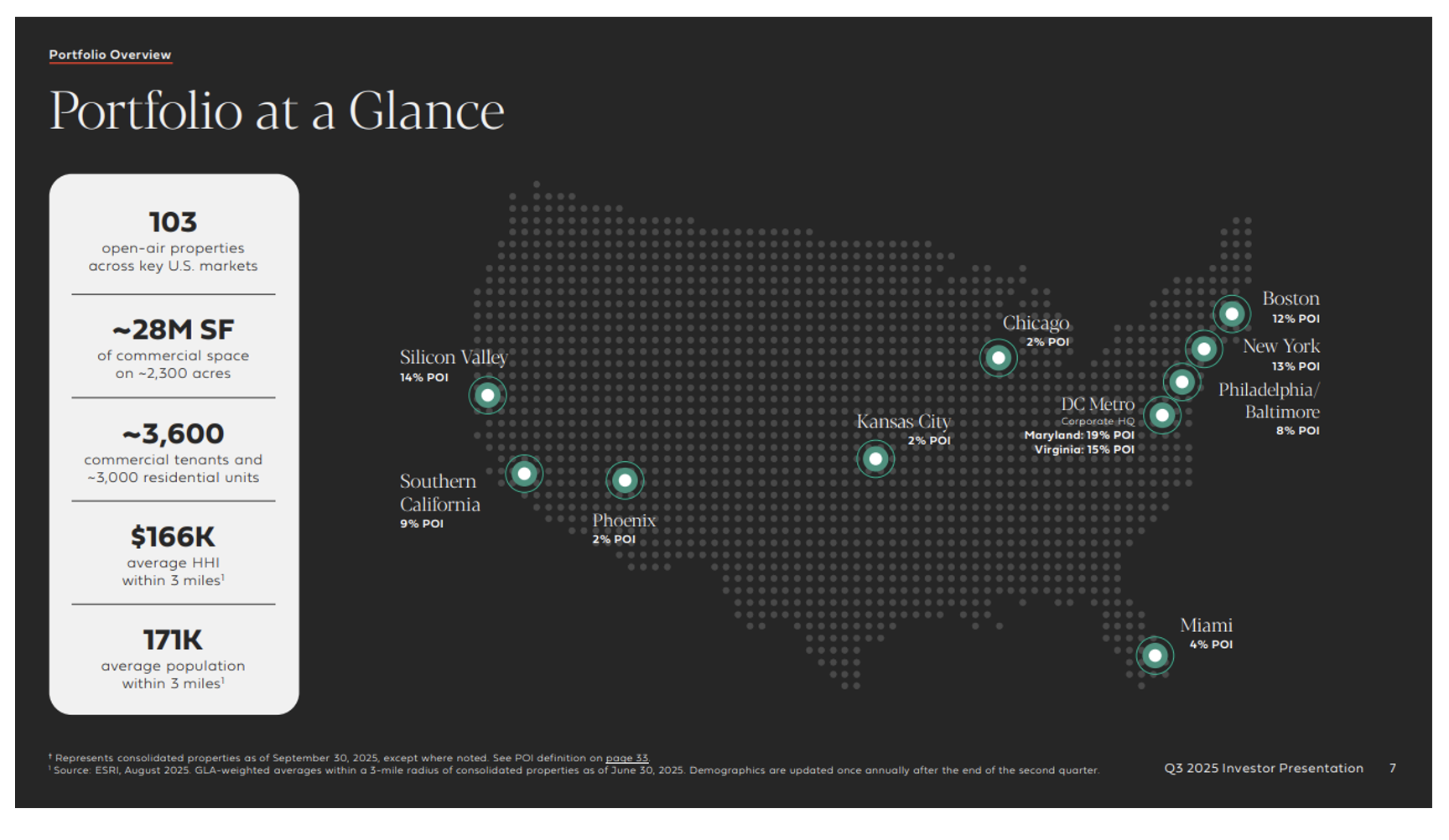
Source: FRT Third Quarter 2025 Investor Presentation
As of September 30, 2025, FRT owned and managed just over 100 open-air properties in major U.S. markets, covering nearly 28 million square feet. Seventy-nine percent of these properties are retail-oriented, with another 11% of annualized base rent (“ABR”) falling into the residential category, and the remaining 10% being mixed-use offices.
The average household income around its properties is $166,000 – which is about twice as much as the U.S. median. In other words, its retailers cater to people with discretionary income.
This makes it easier for them to pay the rent, which is how Federal Realty had a 94% comparable occupancy rate in the third quarter of 2025. Since tenants arguably need to be in these wealthy areas to reach their highest-value customers, that gives the REIT leverage over its tenants.
Moving forward, FRT’s blueprint for growth remains the same: acquisitions. Its most recent move was just last month when it purchased Village Pointe, Omaha’s leading open-air lifestyle center, for $153.3 million.
The sprawled-out property features over 60 shops, including Apple, Nordstrom Rack, and Lululemon. This is hardly a low-end property, to say the least.
Top employers in the area include LinkedIn, Union Pacific, and Berkshire Hathaway. So it shouldn’t be surprising that the average household income within three miles tops $180,000.
Better yet, FRT has the positioning to execute more deals like this in the coming years, all while maintaining its Dividend King status. The REIT’s 4.4% dividend yield is well-covered by a funds from operations (“FFO”) payout ratio that should be in the low-60% range this year.
A King No Matter How You Cut It
Federal Realty’s balance sheet in general is a beautiful thing to behold. Again, you don’t get to the 50-year dividend-raising point without learning how to handle your money like a pro.
Rated BBB+ by S&P and Baa1 by Moody’s, FRT has plenty of cash to draw from as needed and at attractive rates. Its 5.6 times annualized consolidated net debt to earnings before interest, taxes, depreciation, and amortization (“EBITDA”) ratio as of September 30 was close to its long-term target of 5.5 times.
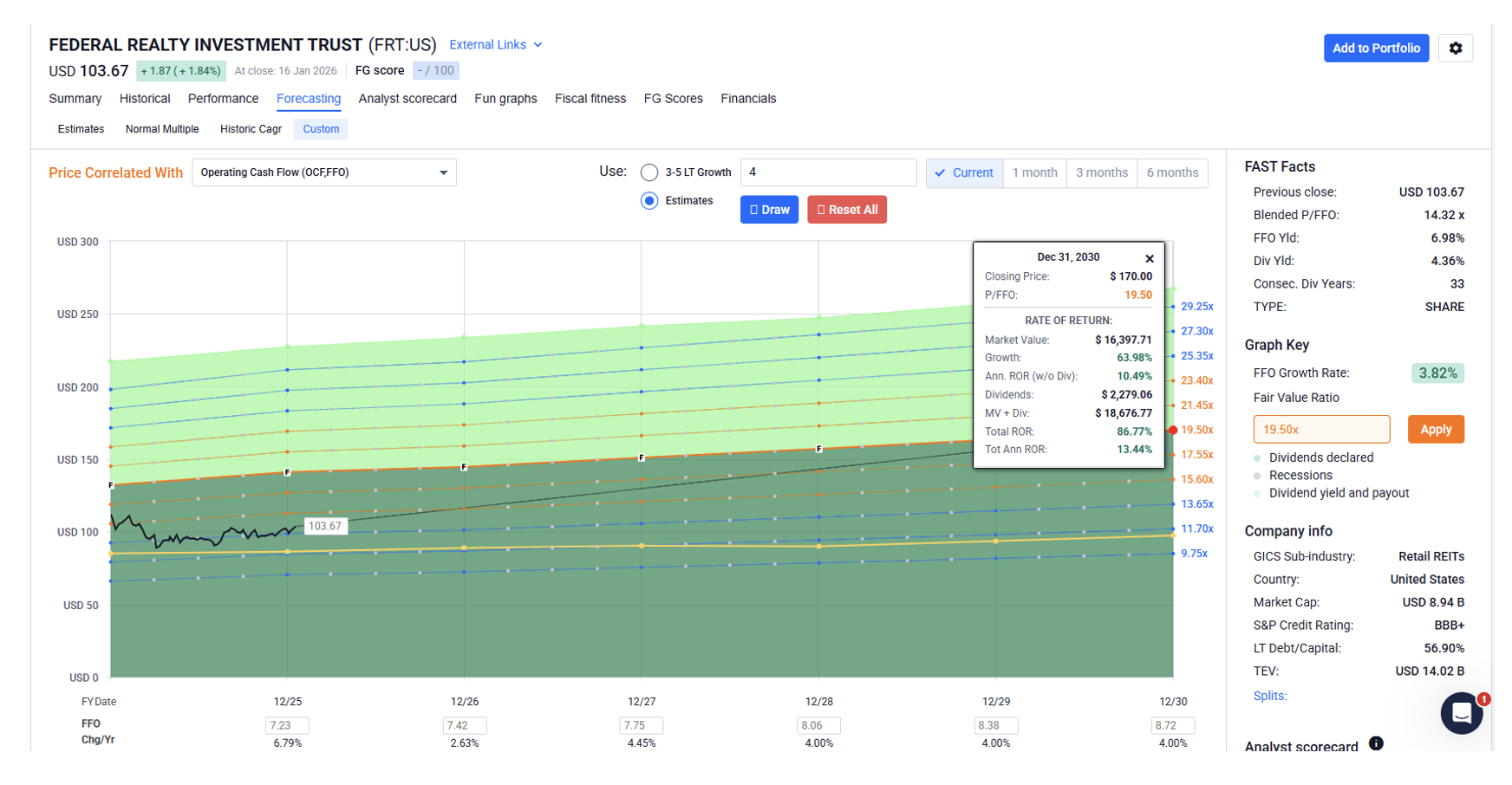
Source: FAST Graphs, FactSet
As a result, the analyst consensus is for FFO per share to compound by around 4.5% annually through 2028 from a 2024 base of $6.77. That’s why we’re confident FRT can build on its 58-year dividend growth streak.
Yet for all of those very positive aspects, shares are sitting at a compelling value. Federal Realty’s $104 share price means it’s trading at a forward 12-month price-to-FFO (P/FFO) ratio of 13.9 times.
This is well below its FAST Graphs-calculated 10-year average of 21.3 times. And it’s 28% under our $145 fair-value per-share estimate.
On the one hand, we get it. Nobody likes REITs right now because of the higher-rate environment we’ve been operating in for years. Too many traders think that REITs automatically suffer whenever interest rates go up.
The reality is that a Dividend King like FRT can thrive regardless of such things. But we’re fine taking advantage of the lowered price point regardless.
Barring an absolute catastrophe, this landlord is a definite bargain. If it matches growth expectations and returns to fair value, that would pave the way for low-teens annual total returns through 2030.
Safe, consistent total returns.
By the time the market realizes FRT should be closer to its historical norm around 20 times P/FFO, the window for a 4.4% yield and double-digit valuation upside will have closed. For the investor running the marathon rather than the sprint, this could be your moment to act.
Regards,
Brad Thomas
Editor, Wide Moat Daily
P.S. Tomorrow, I’ll share another two of my favorite REIT picks that I discussed with Penn State students this week.
|