Every day, I look out my office building window in Spartanburg, South Carolina…
The downtown area where I’m situated is rich with well-preserved buildings full of historic Southern charm. And the scenic Blue Ridge Mountains serve as their backdrop.
Yet we’re also a growing city with plenty of modern appeal. Our new minor league baseball team, the Spartanburgers, opened its state-of-the-art stadium last April. And entrepreneurial investor and philanthropist George Dean Johnson is busy bringing in thousands of jobs through a variety of commercial real estate (“CRE”) projects.
It’s amazing to see. Though I’ll admit all this construction activity is making me remember years past… not all of which were pleasant.
My former business partner was an early mover in developing downtown Spartanburg. His grandfather made a small fortune assembling large tracts of land and investing in textiles, and he wanted to expand on that legacy.
I can see the very last building my partner ever developed from my office window. Today, it’s a beautiful and successful Marriott hotel.

Hotelplanner.com
But it’s also a constant reminder of how my net worth fell from $30 million to negative $5 million. The property went on to ruin him, nearly ruining me, too, in the process.
It was an expensive lesson to learn. But I did learn it. And that experience has helped inform my SWAN (sleep well at night) approach to investing ever since.
It basically boils down to Warren Buffett’s famous “Rule No. 1: Never lose money” and “Rule No. 2: Never forget Rule No. 1.”
Pick Your Partners Wisely
Earlier this week, I brought up Buffett’s famous speech from October 1998 – the one where he spoke to students at the University of Florida, School of Business.
While I disagree with his take on real estate investment trusts (“REITs”) back then, the rest of his presentation was filled with good advice.
For instance, Buffett asked the MBA students to imagine they could buy 10% of one classmate’s future earnings for life. Who would they choose and why?
It would have been easy to pick someone with excellent grades or a high IQ. But that’s not what Buffett was driving at.
He wanted them to consider someone they’d want to partner with long term – someone who had leadership qualities, an honest and generous track record, and who worked well with others. Someone who was humble enough to acknowledge that he or she doesn’t know everything all the time.
People fail for all sorts of reasons – stupidity, pride, or just dumb bad luck. But it takes a person with the right sort of character to rise above it.
Buffett told the students that success is not about IQ, grades, or technical skill. It’s about temperament and behavior over time. He emphasized that:
-
You don’t need to be the smartest person in the room.
-
You do need emotional control.
-
You must avoid self-destructive behavior, especially in extremes.
I learned those lessons the hard way.
I wasn’t personally involved in that hotel project I mentioned earlier. My business partner had his side projects apart from me, and this was supposed to be one of them.
When things went south, however, he started “borrowing” from our shared piggy bank. And when those Plan B measures failed, he “borrowed” some more, all without me knowing. You can probably guess how it ended.
Ever since then, I’ve become obsessed with picking the right partners. And you should, too.
Stay in Your Circle of Competence
Buffett also advised those students to only invest in businesses they could understand. Trading, he essentially said, shouldn’t be about the fear of missing out (“FOMO”), keeping up with the Joneses, or sounding impressive at the water cooler.
It should involve intense research and a healthy respect for what you purchase. You should always understand what an asset does, how it does it, and how it plans to expand before you get involved.
If you can’t reasonably estimate future cash flows, you’re leaving wide open space for something bad to happen.
Unfortunate developments always happen eventually, whether it’s the rise of a new competitor, an economic downturn, or a tenant falling through. It’s only a matter of whether a company has properly prepared during the good times to deal with the bad.
My business partner did not. He had no experience in developing hotels, and I guess he didn’t bother to do the proper research either.
I’m sure he was at least partially motivated by a desire to help Spartanburg grow. And I’m even more certain that he began the project with good intentions.
But you know what they say about good intentions…
Leverage Is a Silent Killer
Buffett also taught that leverage magnifies errors and forces liquidation at the worst moments.
This isn’t to say that borrowing money to build a business is a bad thing. In fact, it’s almost impossible to grow a business otherwise.
However, it needs to be done strategically.
Buffett argued that the average investor doesn’t fail because they’re wrong about a final outcome. They fail because they use leverage to buy in too quickly, which then forces them out at the wrong time.
Once again, that was certainly true of my business partner. He took on too much debt to construct the hotel – absolutely determined to build the first high-quality hotel in the upstate area.
Since the hotel itself is still standing, it’s clear his original vision did work. It just didn’t work for him.
Always Insist on a Margin of Safety
That leads me to my final note of caution and one of the most important investing lessons I’ve ever learned: to always maintain a financial cushion.
This discipline is also known as keeping a margin of safety – something Buffett framed as being “the difference between surviving and being wiped out.”
You never know when cost overruns, analytical errors, bad luck, or unforeseen events might strike. So, you never know when that cash on the side will save your day.
When I look back at my failed business partnership, I’m reminded that development is one of the riskiest careers on the planet. There are so many things to consider, from proper permits to tenant bankruptcies and environmental surprises.
While I personally always included contingency items in my construction budgets… I failed to contemplate what would happen if my partnership fell apart. That was my mistake.
So when the torpedo hit our collective ship, there was no time to escape. I was sunk.
Fortunately, I wasn’t without a life jacket. With my five kids to think about, I had plenty of motivation to stay afloat. And so I did, building myself back, step by step and bill by bill.
The “lost decade” of my life was painful. But it made me the investor and analyst I am today. It taught me to maintain discipline in both my professional and personal life, as well as with any recommendations I offer to readers.
I’ve got two new grandkids on the way, making four in total. I want to leave them a legacy worth talking about.
That’s why I keep this notecard taped to my computer from Warren Buffett’s mentor, Benjamin Graham:
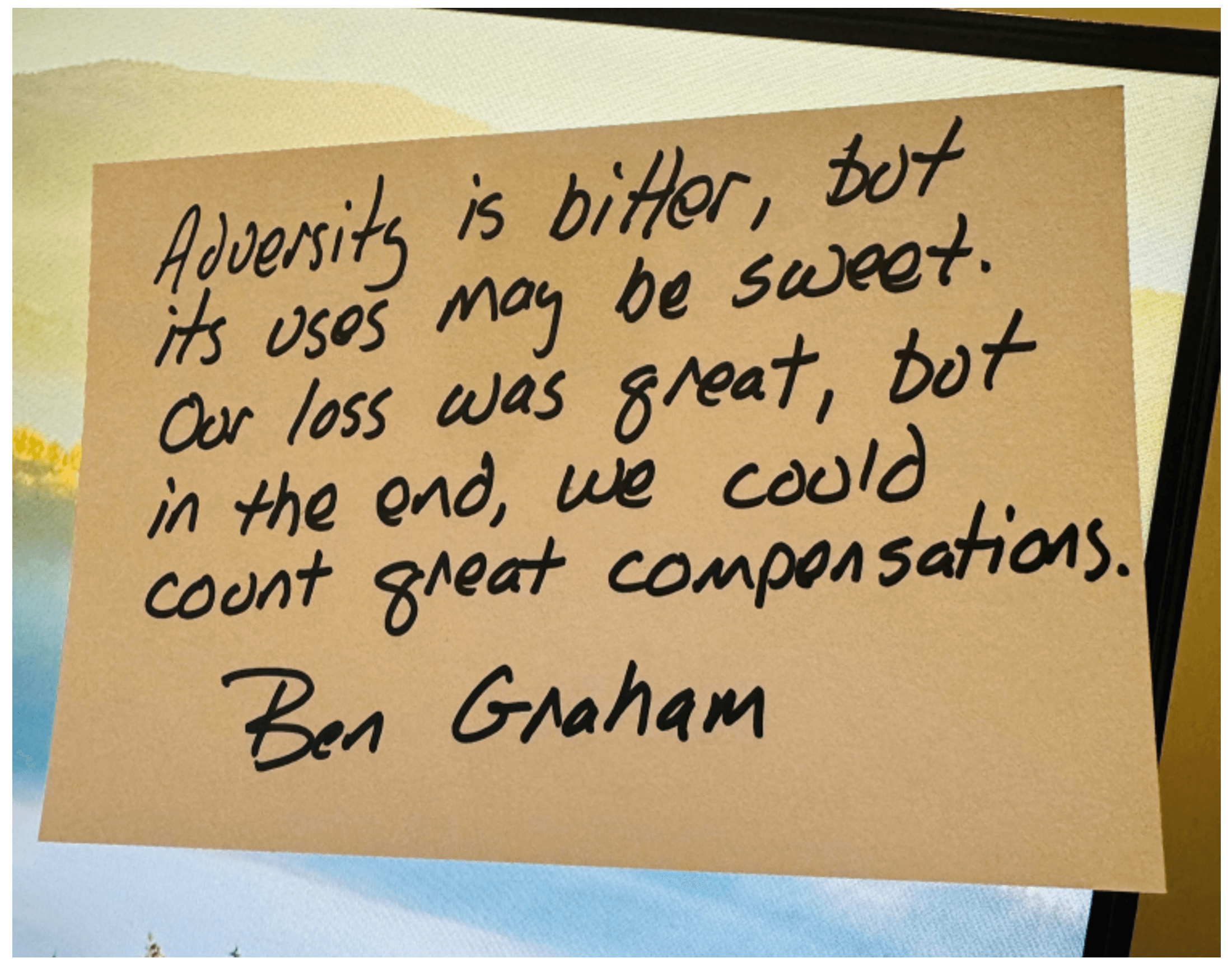
Life is all about how you handle it, the good, the bad, and the lessons you choose to learn.
Regards,
Brad Thomas
Editor, Wide Moat Daily
P.S. In this week’s episode of The Wide Moat Show, Nick and I discuss several companies that could help you build your own legacies. They’re “near-monopolies” with great businesses and wide moats. Give the episode a watch right here. And, if you enjoyed the episode, subscribe to the channel on YouTube. It helps the show reach more people.
|