Editor’s Note: Today, Brad is going back to basics. He’s showing how investors have – for decades – gotten rich the slow-but-steady way. And he shows why a select group of companies is an important tool for any investor who wants to do the same.
Over the past 12 months, approximately $68 billion was paid out to investors in a select group of companies.
Based on my research, these payments will be higher this year… and the next year… and the year after that.
Here’s the interesting part: These payments were mandated as part of the Internal Revenue Code.
I can probably guess what you’re thinking. It sounds too good to be true.
But today, I intend to prove to you that these multibillion-dollar annual payments are very real. I’ll show why they are mandated as part of the Internal Revenue Code. And I’ll share some of my favorite names in the space.
Get Rich the Slow-but-Steady Way
Ask any serious, long-term investor, and they will tell you – compounding regular dividends from stocks can work wonders.
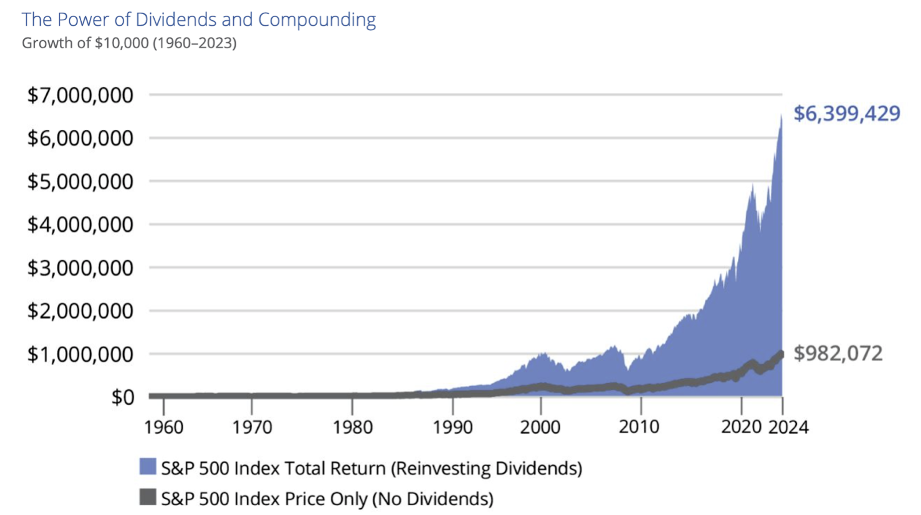
Below is a chart from The Hartford Funds that we share regularly here at Wide Moat Research. What it demonstrates is the incredible impact reinvested dividends can have on a portfolio over time.
Source: The Hartford Funds
Without accounting for dividends, a $10,000 investment into the S&P 500 in 1960 would have turned into approximately $982,000 by the end of 2024. A nice sum, to be sure. But have a look at the data in blue. That same investment, with dividends reinvested, would come to just under $6.4 million. It’s night and day.
This simple observation – that dividends can contribute to the lion’s share of a portfolio’s return – is why so many investors put such an emphasis on buying companies that pay reliable dividends. But that word is important – reliable.
Most public companies that pay a dividend do so at the discretion of the board. Put another way, these companies choose to pay dividends to reward shareholders, but they don’t have to.
There are any number of reasons why a public company may cut, or even suspend, its dividend payment – the business struggles, management wants to preserve capital for other expenses, etc. And if that happens, the snowball-like compounding process illustrated above slows or stops.
And while there are great public companies that have made regular and rising dividend payments for years or even decades (we hold many in our model portfolio), those payments are never a guarantee.
However, there is one group of companies that – due to their corporate structure – must pay out 90% of their taxable income every year. If they fail to do this, these companies will lose a highly advantageous tax advantages that their businesses depend on.
And to understand why this is, we need to dig into one little-known corner of the Internal Revenue Code.
Section 857(a)
Ask most any investor, and they likely couldn’t tell you the significance of Section 857(a) in the Internal Revenue Code. But ask any real estate investment trust (“REIT”) investor, and they know it well.
If you’ve been a reader of mine for any length of time, these assets will need no introduction. But for the uninitiated, REITs are property-owning, rent-collecting companies that pass on the majority of their taxable income to shareholders. For that reason, they are a favorite among income-oriented investors and a specialty of mine. There are REITs that cover just about any property sector you can imagine.
But for our purposes today, it’s important to know that quality REITs tend to pay generous, reliable dividends for years or even decades. And it all comes back to Section 857 of the Internal Revenue Code.
The important piece reads:
The provisions of this part (other than subsection (d) of this section and subsection (g) of section 856) shall not apply to a real estate investment trust for a taxable year unless –
(1)the deduction for dividends paid during the taxable year (as defined in section 561, but determined without regard to capital gains dividends) equals or exceeds –
(A)the sum of –
(i)90 percent of the real estate investment trust taxable income for the taxable year (determined without regard to the deduction for dividends paid (as defined in section 561) and by excluding any net capital gain)
Allow me to translate that…
What it means is that if REITs distribute at least 90% of their taxable income to investors in a given year, they receive special tax treatment. Specifically, they can pay zero federal corporate income tax on those funds.
As you can imagine, this is a very beneficial arrangement for both the companies and shareholders. And it’s why REITs tend to pay very generous dividends when compared with most traditional public companies.
How generous are these payments?
According to data from the National Association of Real Estate Investment Trusts (Nareit), U.S.-listed public REITs distributed approximately $68 billion to shareholders over the past four quarters.
In all likelihood, the sum total of payments made by REITs to shareholders will be higher over the next four quarters. That’s because, as corporate landlords, many REITs structure lease agreements that are yearslong with annual rent “escalators” built in. This allows us to predict with a high degree of confidence what REITs will earn, and what they will pay to investors, years into the future.
Consider the following example…
As I write, Starbucks (SBUX) pays an annual dividend of $2.40 per common share. The stability of that dividend, and any future increases, will depend on the fundamental growth of the business. And while Starbucks is a solid business with a great brand, the future is always uncertain. If Starbucks struggles, for whatever reason, that dividend could be in jeopardy.
Now, consider a hypothetical REIT that owns a collection of Starbucks stores. These leases with the Starbucks company would be yearslong with annual rent increases built in. While not a certainty, the annual rent paid to this REIT could be predicted with a high degree of confidence for this year, the next year, and the year after that. After all, rent is typically the last thing that a company stops paying.
What this means is that, all else equal, quality REIT payments tend to be higher and more reliable than traditional C-corporation dividends. That’s due to the REIT structure outlined in the Internal Revenue Code as well as the contractual nature of these lease agreements.
Notice I use the word “quality.” That’s because, despite all these shareholder benefits, REIT dividends can still be cut.
Very often, these dividend cutters are what I refer to as “sucker yields,” or companies that are paying out far more than they are bringing in. And it’s why we spend so much time researching the fundamental soundness of any REIT we recommend.
But it goes to show that, if your goal is to build wealth the slow-but-steady way, REITs are a tool that deserve to be in your arsenal. And it’s why we spend so much time covering these stocks.
Regards,
Brad Thomas
Editor, Wide Moat Daily
P.S. New buildings are popping up all over America. Some are near major cities. Some are outside little towns you’ve never heard of. Many are nondescript. But they all have one thing in common – they are the cornerstone of a new industrial revolution taking shape in America. I refer to them as “Economic Profit Zones.”
I recently visited one of these buildings, and the experience was eye-opening. You can get the full story – and learn about the stocks connected with this trend – right here.
|