Markets got some good news last week. President Trump announced the reopening of the Strait of Hormuz – a move later confirmed by Iran’s foreign minister.
Oil traders reacted immediately, with Brent crude falling roughly 12% to around $87. That was its lowest level in six weeks, a drop that also sent energy stocks down.
Airlines and travel-related stocks surged on the prospect of lower fuel costs. U.S. equities in general pushed to new highs. Fueled by hopes that inflation pressures would ease, the S&P 500 crossed the 7,100 mark.
That lasted for about a day…
On Saturday, we got the news that Iran was closing the Strait of Hormuz again until the U.S. ended its blockade of Iranian ships. And Sunday’s news was that Trump was done being “Mr. Nice Guy,” complete with the declaration that he’ll bomb “every single” bridge and power plant if Iran doesn’t start cooperating.
Nobody knows what will happen next.
But we can expect one thing – volatility is here.
So, what’s an investor to do about it?
The Dividend-Paying Way
Here at Wide Moat Research, we take volatility in stride. We don’t need to predict oil’s next big move. And we don’t bother keeping up with the Joneses or fretting about missing out on day-trading opportunities.
What we do is prioritize SWAN (sleep well at night) stocks with their durable business models, reliable income streams, and strong balance sheets.
Geopolitical changes – even violent shifts like the ones we’re seeing this year – can create a lot of temporary noise. But no matter how it might feel in the moment, these dramatic headlines rarely change a high-quality company’s long-term fundamentals.
Iran could very well keep us guessing for days… weeks… or even months more. We just don’t know.
Yet our job as SWAN investors isn’t to predict which global player will do what and when. It’s to own assets that keep profiting no matter what the headlines say – dividend-paying stocks, preferably.
Naturally, quality dividend-paying companies have the best track records in this regard. So that’s what we focus on. No yield chasing for us.
We like a high yield as much as anyone, mind you. But we also understand that it isn’t an automatic indication of long-term investment success. If anything, it can be a warning sign of unhealthy operations.
That’s why we prioritize quality first. If a company doesn’t display that consistent characteristic, we probably don’t want it.
Our goal is to own businesses that can grow their payouts over time in a sustainable way. That means they have to have disciplined management teams overseeing durable cash flows and strong balance sheets.
And that kind of capability almost always comes with a “wide moat” – some carefully cultivated business aspect that keeps it safe from competitive encroachment. This often comes in the form of size (or scale), brand strength, or contractual revenue.
Regardless, companies with true market advantages don’t need market conditions to be perfect all the time. They build their businesses with the full understanding that the economic sun doesn’t always shine, and so they always plan for a rainy day.
That way, when storms do strike, their shelters stay strong.
My Favorite Kind of Wide-Moat Stocks
Real estate investment trusts (“REITs”) stand out in the wide-moat conversation for a very specific reason. They’re required by law to distribute at least 90% of their taxable income in the form of dividends.
That sets them apart from traditional C-corporations, which can decide quarter by quarter whether they want to offer dividends and, if so, by how much. Since REITs absolutely have to pay their investors directly under almost every circumstance, they tend to plan accordingly.
That means both borrowing wisely and buying wisely.
When any company does that, the Strait of Hormuz can open and close repeatedly without affecting its long-term prospects. And when a dividend-paying company does that – just as long as its underlying business model remains intact – its investors keep benefitting quarter after quarter or even month after month.
Some REITs still manage to mess this up, of course, as I covered last week. So you still need to focus on finding quality names such as Realty Income (O), Agree Realty (ADC), and NNN REIT (NNN).
All three are net-lease REITs that churn out regular dividends thanks to their defensive, wide-moat attributes. They’re also trading at a margin of safety right now, which is also exceptionally important.
You never want to pay a premium for a stock, no matter how good it looks.
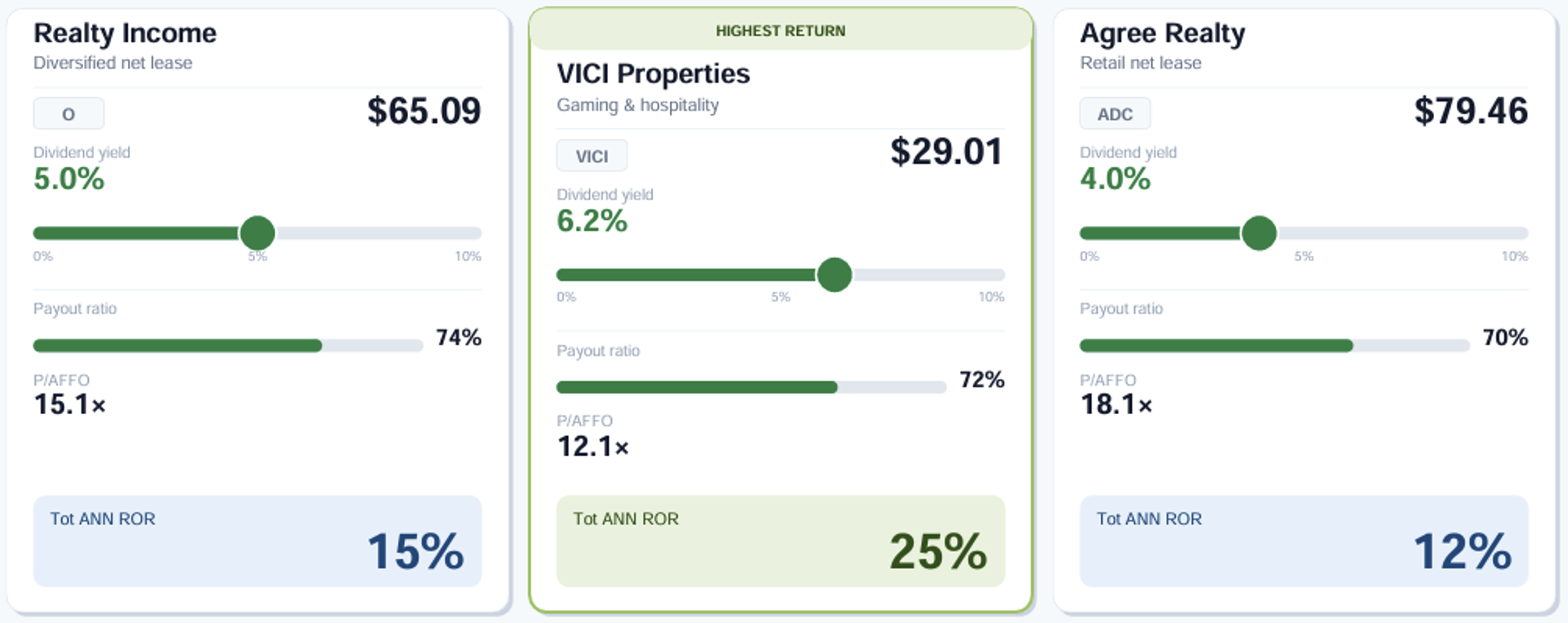
Source: FAST Graphs
Fortunately for us, there are plenty of REITs on sale right now.
The same holds true of other strong, dividend-paying sectors such as utilities, infrastructure, and consumer staples. These businesses provide essential services that often give them predictable profits and pricing power regardless of what’s going on in the world.
In uncertain environments, that kind of income isn’t just a bonus… It’s an anchor. Dividends can provide real, tangible returns that don’t depend on market sentiment, multiple expansion, or short-term price movements. They tend to show up regardless of whether headlines are optimistic or alarming.
From a psychological standpoint, that consistency can keep investors from panic-selling. And from a financial standpoint, not panic-selling can mean the difference between an enjoyable retirement… and one filled with struggles.
So, the next time you see discouraging headlines, don’t worry. Just think about your dividends.
Maybe even use it as an opportunity to buy even more of them.
Regards,
Brad Thomas
Editor, Wide Moat Daily
|