I’m a big believer in the power of compounding.
It’s not the most exciting idea to put into practice, I know. But it’s one of the most effective ways to achieve desirable long-term effects in just about every aspect of life.
Apply this concept consistently to your job, your relationships, your possessions, your money… and you’re very likely to see great results over time.
We’ve proved that over and over again with our Wide Moat Letter, which researches dividend-paying sleep-well-at-night (SWAN) stocks that open up excellent compounding opportunities.
As my colleague, Nick Ward, recently wrote me:
Since we launched these portfolios in 2020, we’ve never experienced a dividend cut. More recently, our focus on fundamental growth and attractive valuations has allowed us to beat the S&P 500 on a year-to-date basis, up 7.7% versus 5.6%.
He then added that:
Overall, we’ve made more than 35 sales across our portfolios with an average gain of 25.5%. Of our remaining long positions, the vast majority are up double digits, with several triple-digit winners still running higher.
Subscribers then have the option of reinvesting dividends back into those stocks to receive even more dividends…
Which can buy up more shares…
Which produces more dividends in a beautiful, sustainable, compounding cycle.
It’s not difficult in theory, but it can be easy to get derailed in practice. That’s why I put together some helpful tips to aid you along the way.
Add in a publicly traded company that exemplifies this quiet power in all the best ways, and I think today’s Wide Moat Daily is well worth the read.

Source: Wide Moat Research
Compounding Tip No. 1: Ask yourself, “And then what?”
Most people are capable of creating great goals. It’s just the execution they waver in.
Sometimes, they try to take shortcuts. Other times, it’s the exact opposite: They add unnecessary steps or responsibilities that only make the waiting game more miserable.
Consider an employee faced with the choice of staying late at work to impress his boss. It might seem like a worthwhile sacrifice in the moment, but he’d be much better asking himself, “And then what?”
Perhaps it will be a mere one-time effort that makes him look good to management. However, it could also easily set a precedence that compels him to work late more regularly, leaving him drained with nothing to show for it.
Or consider the possibility of selling one of your steady-growth stocks in order to buy the hot company everyone’s talking about. That idea might feel great in the moment…
But then what?
You’re left chasing momentum without a safety net.
Hot stocks have a very bad habit of becoming yesterday’s news – or, worse, outright negative news – in the blink of an eye.
Recognize that every decision you make costs something: time, money, assets, opportunities. There is no free lunch, and you need to weigh each opportunity carefully to make sure it’s worth your while.
That’s one of the definite benefits of compounding. When you really put it into practice, it helps you avoid the kinds of missteps that jeopardize everything you’re working toward.
Compounding Tip No. 2: Start with what you want to avoid.
Most people chase achievements. But the wise accept a dual mandate: Seek success AND avoid failure.
If you consistently avoid big mistakes, good things tend to compound on their own.
This isn’t meant to paralyze you from making decisions, mind you. Once again, it’s to encourage you to make wise ones.
We know it’s not always easy to stick with compounding week after week, month after month, and year after year. There are too many distractions out there: too many temptations to follow the get-rich-quick crowd. Or to give in to fear during rough patches.
I’ve been there and done all that myself. So I know from very personal, very painful experience how poorly life can go when we lose focus.
I’ve said many times that my goal here at Wide Moat Research is not only to help readers grow their wealth… but also to protect that wealth by avoiding the mistakes I used to make.
So take it from me now that I’m older, wiser, and in possession of a safe, sound, growing retirement portfolio. Whenever something shiny and new comes along to tempt you away from the truly good thing you’re going for, just remind yourself that you don’t want to lose money.
Then walk the other way.
Compounding Tip No. 3: Celebrate the small wins!
We all enjoy instant gratification, at least in the moment. But too much of it never ends well.
Too much food adds to our waistlines. Too much TV weakens our brains and bodies. And too much “self-expression” destroys relationships.
Most of the best things in life require patience and sacrifice. They need regular reinvestment to become everything we hope they can be.
At first, progress might feel slow enough to feel pointless. Yet as you keep reinvesting your time, efforts, and/or dividend payments to increase your holdings, those small, consistent gains begin to stack up.
So if you’re just starting out with compounding your dividends – or anything else – celebrate every gain you make. Each one is pushing you closer to exactly what you want, as you’re about to see.
Real-Life Compounding: Realty Income
I love pointing out Realty Income (O), aka “The Monthly Dividend Company,” whenever I write about compounding. This net-lease real estate investment trust (REIT) pays out a monthly dividend – which it’s raised annually for over 35 years in a row now.
Do you know how much you can make by reinvesting it over time?
Say you put $1,000 in O. In that case, your payout will be pretty small that first month: not even enough to buy a full share.
But if you reinvest it anyway, it will be slightly bigger that second month. And slightly bigger again the third.
By the time you’ve hit the 12-month mark of this consistent reinvestment plan, you’ll actually own more shares than you started with.
Most dividend stocks pay out every quarter, which can add up nicely, too. But I definitely prefer Realty Income’s way of doing things. That higher frequency matters, turning the quiet power of compounding up to a faster pace.
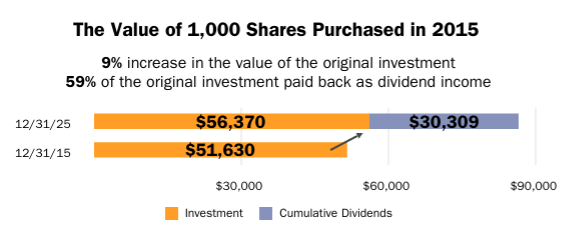
Over the course of two decades, a large portion of your total return would come from the dividends alone, not just share price, as shown below…
Source: Realty Income
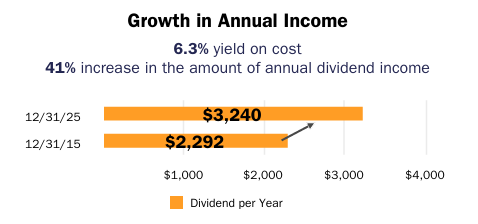
In addition, the growth in annual dividend income would have been over 41% thanks to a 6.3% yield on cost.
Source: Realty Income
That’s what a quality dividend-paying investment can do when you apply wisdom, dedication, and patience to it. As the late but great Charlie Munger put it, “The first rule of compounding is never interrupt it unnecessarily.”
The results are almost always well worth the effort.
Happy SWAN investing!
Brad Thomas
Editor, The Wide Moat Daily
|