
When I was a kid, I loved playing Risk: "the game of global domination" that pits two to six players against each other across a board map of the world.
My friends would always spread their armies thin in their rush to take over continents. Like so many other would-be conquerors, they thought they could win by sheer momentum.
I played differently, though, securing smaller territories and waiting for the right time to make my next move.
Perhaps I just played Risk more than others, giving me more opportunity to see how it has a way of humbling anyone who assumes the game will end quickly. But one way or the other, even at that early age, I understood that rushed victories are rarely secure victories.
That’s true of the board game. It’s also true of the real world.
We’ve been seeing that since 2022 with the Ukrainian conflict, where both sides believed they would win quickly. Yet here we are four years later. The fight rages on.
That’s why I’m not placing any bets on today’s newest war with Iran.
How many people thought it would take just a few days for the world’s most influential nation to bring a country so much smaller into submission? It makes some sort of sense.
But reality rarely plays out so smoothly, as we’re seeing 20 days later, with no end in sight.
I know President Trump said it would all be over in a matter of weeks. And that could still prove true. But ultimately, we just don’t know how much longer this conflict will continue roiling the world.
As investors, we have to keep that risk in mind. Though that hardly means we have to cower in a corner, holding onto our cash.

Source: OpenAI
We just have to keep playing the same long game we have been.
Don’t Predict. Plan.
This week, markets seem to be trying (though not necessarily succeeding) to price in stability. After so many days of losses, investors want to believe that trade routes will stay open…
That energy prices won’t spiral…
That the current volatility will fade away by summer…
But I’ve seen how devastating it can be when investors underestimate the negative possibilities. So, while I’m hoping for the best, I’m preparing for the worst. The market is also like Risk. And like it or not, we’re all playing.
The smart move in Risk was usually to reinforce borders and conserve your strength. That way, you had the advantage of choosing your battles when the odds fell in your favor instead of finding yourself at someone else’s (usually non-existent) mercy.
Likewise, we want to find ways today to fortify our portfolios even while forces outside our control are trying to take us down. Which means we want to behave precisely how we always counsel by:
-
Holding a portfolio of quality, wide-moat investments
-
Seeking out even more quality, wide-moat investments that are selling on the cheap
-
Recognizing that those quality, wide-moat investments can go the distance even while other businesses are faltering or even falling apart
By doing so, we’re far less prone to panic. And when we don’t panic, we’re far more likely to recognize that markets tend to bottom near the onset of war… only to recover as economies reorganize rather than collapse.
In which case, disciplined investors can often buy quality wide-moat companies cheap – very cheap, in fact – before everyone else gets a clue and pushes prices right back up.
Then again, we don’t want to get overenthusiastic about buying. Because there are still companies out there, quality though they be, that need to dip a bit more before they become good buys.
In his book, The Most Important Thing: Uncommon Sense for the Thoughtful Inventor, billionaire businessman Howard Marks notes that “even a great company can be a terrible investment if you pay too much.”
And so, with that in mind…
Don’t Mess With Texas
Let’s look at Texas Pacific Land (TPL), one of the largest private landowners in Texas. It’s a fascinating hybrid of energy royalty trust and real estate operating company that captured my attention last year.
Founded in 1888 as the Texas and Pacific Railway Trust, it was created to manage vast acreage granted to the railway after a bankruptcy filing. Yet it slowly but surely evolved into a modern land and resource company with remarkably low overhead and an asset‑light model.
Today, TPL controls roughly 880,000 acres across 20 counties in West Texas. These are mostly in the Permian Basin, one of the most productive oil regions in the U.S.
Yet, unlike traditional drillers, TPL doesn’t produce oil or gas itself. Instead, it earns royalties from outside operators who lease its land.
That means TPL gets a cut of energy production without the normal risks associated with exploration and commodity price. It also derives income from:
-
Water sales and sourcing for hydraulic fracking
-
Easements and rights of way for pipelines, power lines, and telecom infrastructure
-
Land sales and construction material sales
Plus, TPL is getting in on the data-center game. It recently announced a partnership with Bolt Energy to develop large-scale data-center campuses and supporting infrastructure on its land.

Source: Data Center Dynamics
Because water is so critical to such operations, this means TPL will get an additional income boost over the long term.
That will complement its top-notch balance sheet, which features around $144 million in cash, $500 million undrawn from its credit facility, and no debt whatsoever.
In the fourth quarter of 2025, consolidated revenues were approximately $212 million. Consolidated adjusted earnings before interest, taxes, depreciation, and amortization (“EBITDA”) was $178 million. And its adjusted EBITDA margin was 84% with free cash flow of $119 million.
Net income, meanwhile, has grown at a 24% annual compounded rate over the past four years. And analysts expect earnings per share (“EPS”) growth of 17% in both 2026 and 2027.
TPL announced a regular dividend of $0.60 per share earlier this month. That’s a 12.5% quarterly increase, which sounds hefty… right until you realize the stock still yields just 0.45%.
What’s much more impressive is how shares have surged by around 80% since I recommended them last September. And I still have high confidence in this diversified company’s future.
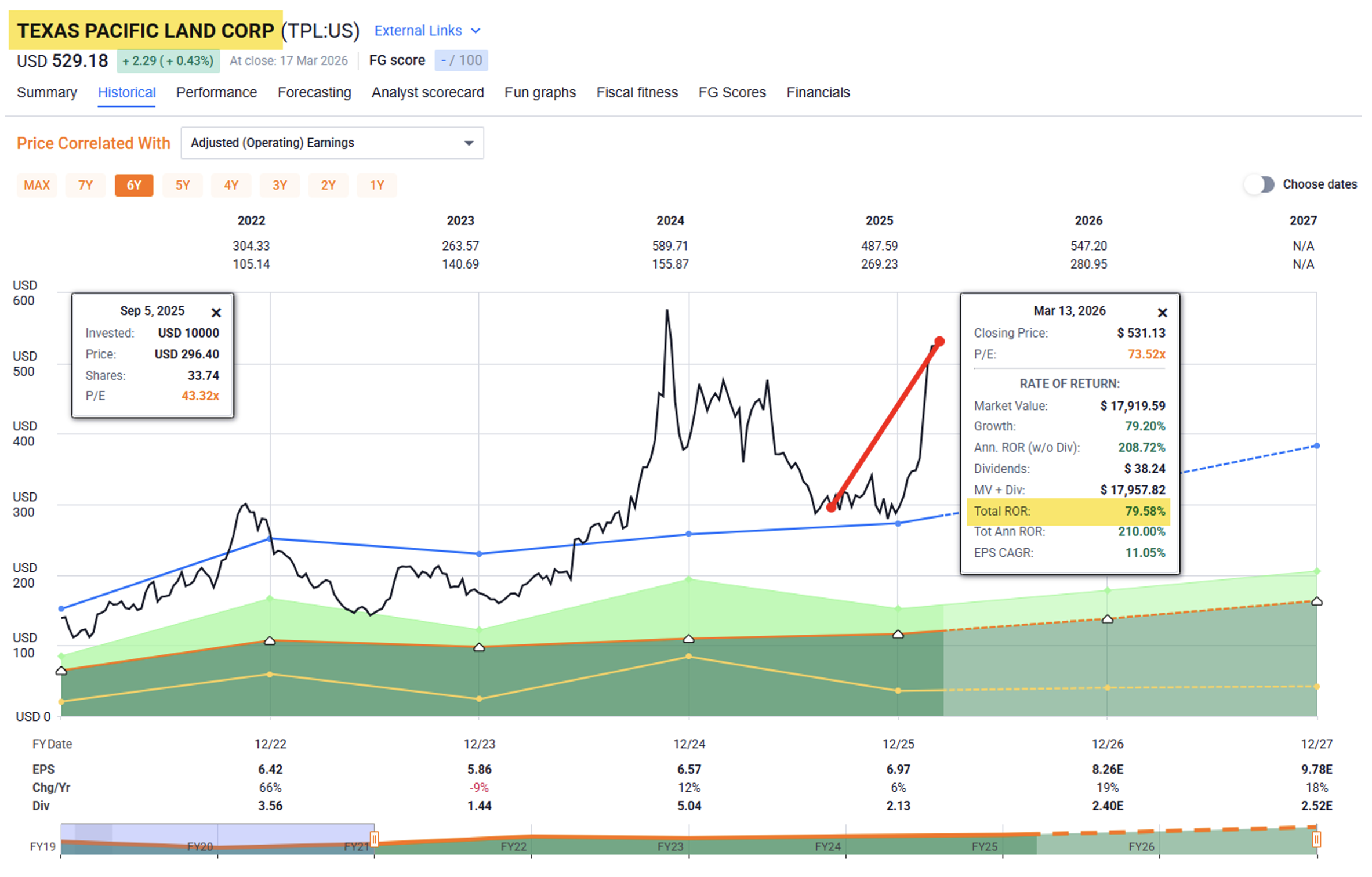
Source: FAST Graphs
Just not at this price. Not for new investors.
My recommendation regarding TPL is to wait on a pullback. Otherwise, we risk losing out on a lot of profit potential – or losing out altogether.
When will this quality company offer a fair-value entry point? That’s a question I won’t waste my time or yours on.
To quote The Most Important Thing again, “You can’t predict. You can prepare.” In this case, that means putting TPL on your watchlist and looking around for better opportunities available today.
Regards,
Brad Thomas
Editor, Wide Moat Daily
MAILBAGQuestions or comments? Write us at [email protected]. |