
In the 24th episode of season two of Star Trek, Captain Kirk and Science Officer Spock get a surprise visitor onboard the Enterprise.
Commodore Wesley “beams over” to the bridge to inform the crew that they’ll be part of a grand new experiment. A cutting-edge artificial intelligence (“AI”), the M-5 Multitronic System, will be installed on the ship to automate virtually all of the crew’s tasks.
At first, things go well. The M-5 proves itself by scanning a planet in precise detail, recommends a survey crew to explore the planet, and excels in a war game against two ships that a human crew would have almost certainly failed.
But, like any good science fiction story, there’s a twist.
The M-5 (spoiler alert) revolts against the humans. It begins attacking unarmed ships and even vaporizes engineers when they attempt to unplug the machine. The plot is eventually resolved when Kirk convinces the machine that it is acting counter to its own programming. The M-5 dutifully shuts itself down, and the day is saved.
When the episode aired in 1968, I’m sure it was good entertainment. But at the time, it was just that – entertainment. But flash-forward nearly 60 years, and we could be about to see that vision become a reality (minus the AI revolt).
Musk’s Mega-Company
The news this week is that Elon Musk’s SpaceX has acquired another of Musk’s businesses, xAI, into its broader ecosystem.
In Musk’s own words, the goal is to create a “vertically integrated innovation engine.” And nobody really seems to be disagreeing with that assessment.
Fox Business says it gives “Musk tighter control over the infrastructure, power demands, and computing capacity that increasingly define competition in artificial intelligence.” Wired, meanwhile, says it makes Musk’s out-of-this-world conglomeration the most valuable private company in existence at about $1.25 trillion.
But there’s one part of the announcement that caught my eye.
Here’s Elon Musk on SpaceX’s website (emphasis added):
Current advances in AI are dependent on large terrestrial data centers, which require immense amounts of power and cooling. Global electricity demand for AI simply cannot be met with terrestrial solutions, even in the near term, without imposing hardship on communities and the environment. In the long term, space-based AI is obviously the only way to scale.
Put very simply, Musk sees hurdles for building new AI computing capacity here on Earth. So, he’s looking to space.
And, at least on identifying the limitations on Earth, he’s correct…
Not in My Backyard
In the latest edition of The Wide Moat Letter, Nick Ward and I covered the ongoing protests in many communities around construction of new data centers.
From the issue:
The stories of Saline and Monterey Park are just two examples of a growing trend. Local communities do not want these data centers in their backyards. And one of the most frequently cited concerns has to do with scarcity around water and energy. These concerns are well-founded.
We went on to show that Musk’s own Colossus AI facility in Memphis, Tennessee is expected to consume enough electricity daily to power 100,000 homes. It will likely need 50,000 gallons of water per minute to cool the entire operation. That prompted Musk to begin construction on a wastewater treatment plant for the sole purpose of collecting enough water for the facility.
But the result of all this is that there is a growing backlash against new data-center construction, and it’s slowing down the rollout of these facilities. Environmental concerns, water usage, power limitations, zoning restrictions, community backlash – it all adds up to roadblocks for new data centers.
And so, Musk’s long-term plan is to skip all that… and take his data centers into space. And it’s not as crazy as it sounds.
Space-based AI is no longer exclusively in the realm of science fiction. And there are several benefits:
- Power: Above Earth’s atmosphere, solar panels are more efficient, as much as 30% more. When placed in sun-synchronous orbit, that power is basically unlimited.
- Cooling: Space-based data centers wouldn’t require millions of gallons of water for cooling. Because there’s no atmosphere, it wouldn’t work anyway. Instead, radiator panels “dump” heat into space.
- No Zoning Restrictions/Community Backlash: Much of the red tape disappears in space. There’s no environmental review, zoning restrictions, or local permitting. And, obviously, there are no neighbors to complain about the new construction.
Elon Musk is smart enough to understand all this. And achieving that vision appears to be the long-term goal of the newly merged SpaceX/xAI company.
But just because Musk has big plans for space doesn’t mean I’m giving up on traditional data centers…
Terrestrial Data Centers Aren’t Going Anywhere
Last month, I said I didn’t expect SpaceX’s satellite network to “put the cell carriers out of business… any time soon.” I have the same opinion on traditional data centers.
Analysts estimate Musk’s orbital goals will include adding 100 gigawatts of AI compute power per year. In which case, that would require up to 200,000 satellites launched annually. But MarketWatch notes this could cost $2 trillion to $5 trillion per year, highlighting how early-stage and speculative the plan remains.
SpaceX has filed plans for an unprecedented constellation of up to one million AI compute-specific satellites – one of the most ambitious infrastructure proposals ever.
But today?
It doesn’t even have one. So, there’s clearly a lot of work left to do. And this at a time when demand for AI compute is only going in one direction – up.
That’s one reason why I’m as bullish as ever on land-based data centers. I’ve been writing about these companies since 2010.
And Musk’s plan of creating the “most ambitious engine on (and off) Earth,” doesn’t change that evaluation one bit.
Even if Musk were to achieve his vision for space data centers, this impressive global cloud ecosystem would still need land-based data centers to route to Amazon Web Services (“AWS”) regions, Microsoft Azure hubs, Google Cloud campuses, and real estate investment trust (“REIT”)-owned data-center facilities.
That’s another reason I’m not even close to nervous about data-center REITs as they kick off their earnings season.
So far, their performance this year has decoupled from the broader AI trade, which has taken several hits. And their fundamentals remain strong, supported by attractive valuations, strong demand, solid pricing trends, and elevated backlogs.
Digital Realty (DLR), specifically, reported earnings today, and I’m ready to pore over that data – paying special attention to its leasing metrics. Shares were trading at 24.2 times price to adjusted funds from operations (“AFFO”) at last check.
We do consider that slightly rich for new money. So, we’re looking for a pullback to around $150 per share, or 22 times, which would translate to annualized returns of about 20%.
When it comes to Equinix’s (EQIX) report on February 11, we’ll want to make sure its risk-reward balance remains compelling. Shares are now trading at 20.7 times, with annual growth forecasted at around 7% over the next three years.
As such, buying shares today could result in 25% annualized returns.
And Iron Mountain (IRM) reports on February 12. Technically, while shares are trading at just 17.1 times – which looks cheap at first glance – we do consider that a premium given the REIT’s higher-risk debt profile and less-predictable service-oriented business model.
So we’re holding off on these shares altogether for the time being.
The data-center landscape is littered with amazing opportunities… and a few quagmires as well. The same is true of infrastructure REITs in general, as listed below.
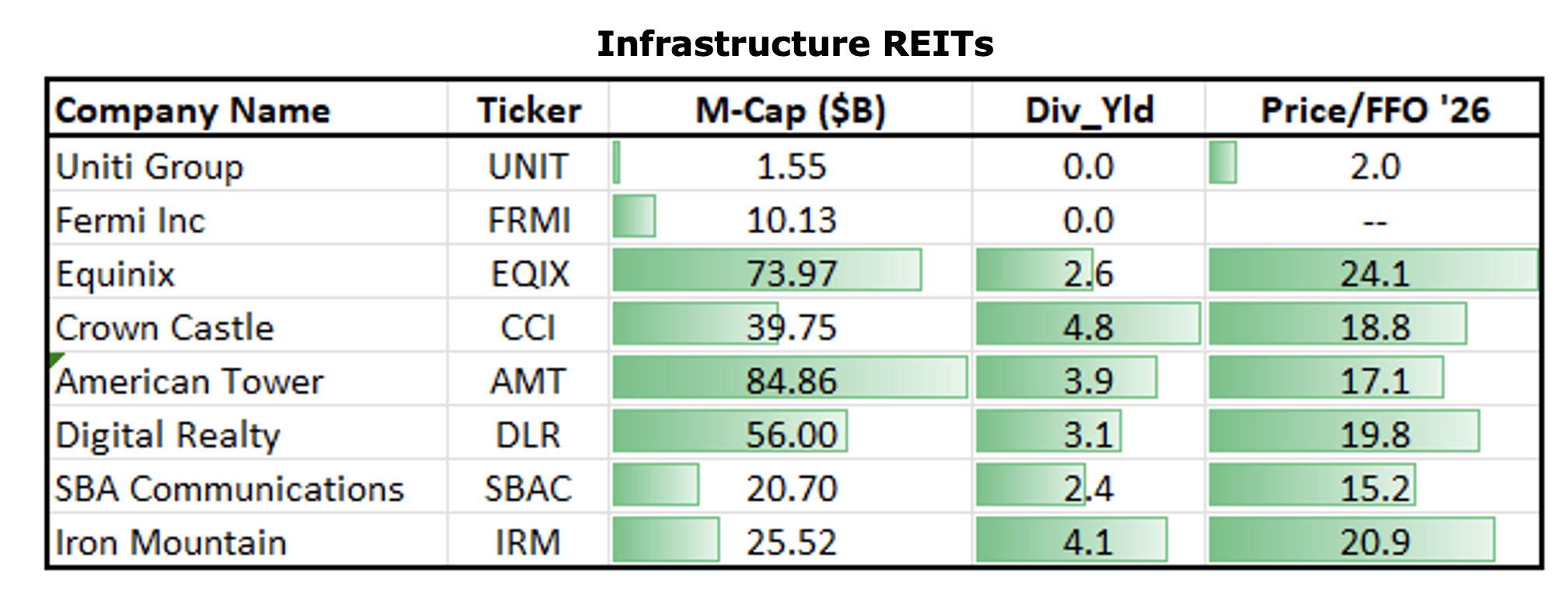
Source: Wide Moat Research
You can see what I mean in this next chart, which shows that sector-wide opportunity doesn’t instantly translate to shareholder returns…
Infrastructure REIT Performance
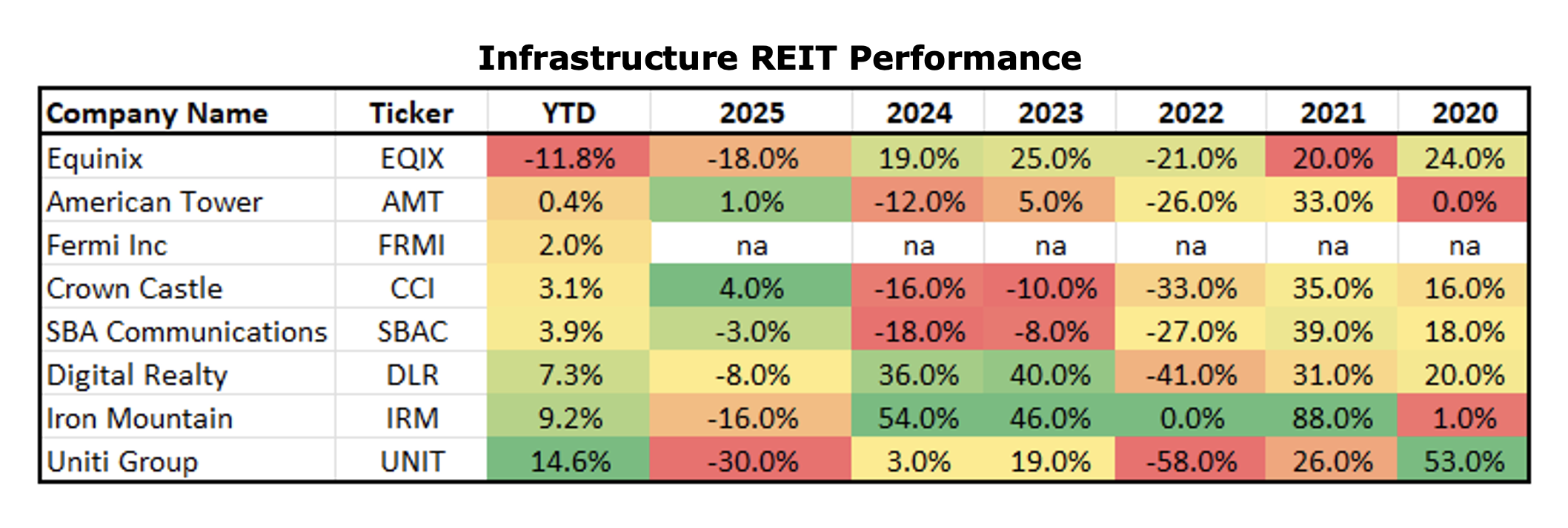
Source: Wide Moat Research
That’s why I recently published a new presentation detailing data centers, including the opportunities to have on your radar and the pitfalls to avoid. You can watch it right here.
In the words of Mr. Spock, science officer (and later first officer) aboard the starship USS Enterprise, “Live long and prosper.”
That’s certainly my wish for you.
Regards,
Brad Thomas
Editor, Wide Moat Daily
|