Decades before I analyzed a stock chart or published a market research report, I was learning about companies firsthand.
I had no idea how useful my commercial real estate (“CRE”) development experience would become. I just thought I was following my career aspirations by creating retail space for growing companies like:
-
Walmart
-
Blockbuster
-
Advanced Auto Parts
-
Dollar General
-
CVS
I always strove to sign contracts with quality businesses with strong cash flows, which is why I was attracted to Sherwin-Williams (SHW). That paint manufacturer, distributor, and retailer knew how to run its business back then.
It offered high-level products at prices that neither sought to undervalue its work nor gouge its customers. Whenever I built a new store for it, I knew there was nothing speculative about the project. There would be no drama on their end – not in the planning stages, not in the construction stages, and not in the rent to follow.
Sherwin-Williams always took care of its properties as per our triple-net-lease agreements. And its lease checks showed up on time every time.
I know that was a while ago, and companies can change drastically from one decade to the next. But now that I’m a Wall Street analyst, I like to monitor the stocks I used to build for, SHW included.
And let me tell you…
That company has remained faithful to its original mission, providing quality products to homeowners and CRE alike.
It’s still as trusted as ever. It’s still as well-managed as ever. It’s still as reliable as ever. So when I see its stock price drop a bit since the war with Iran began, I don’t doubt its staying powers.
I’m just thankful Mr. Market doesn’t know the value of paint the way that I do.
The Sherwin-Williams Way
I still have a business agreement with Sherwin-Williams today. Only this time, it’s not in the form of a lease… It’s through the shares I own.
Shares that pay me promptly and repeatedly every quarter I hold them.
In fact, Sherwin-Williams has paid and raised its dividend every single year for the past 47 years no matter what. It doesn’t matter if there’s a war raging, an economy struggling, or high inflation.
This company has kept its commitment to its shareholders just like it’s kept its commitment to its customers (and its landlords).
Founded in 1866, Sherwin-Williams knows how to take life’s lemons and make Icy Lemonade, Lemon Twist, Lemon Chiffon, Pineapple, Banana Cream, and an entire array of other shades of yellow. Over the past decade alone – even with all the inflationary drama and consumer pains we’ve seen – its stock has returned more than 400%.
That’s how wide of a business moat it maintains.
Wide-moat companies purposely develop structural advantages that protect them against competitive efforts. This might be through a cult of personality or product, such as the one Apple (APPL) created. It might be through the kind of unifying marketing campaign that Coca-Cola (KO) has carefully crafted over the years. Or it could be achieved through scale economies, distribution control, or capital discipline, to name a few techniques.
Sherwin-Williams didn’t select just one of those, though. It created multiple moats by first making top-notch paint and then developing a “floor to ceiling” business model that keeps its customers locked in. Contractors and builders rely on it for credit terms, project analysis, and service reliability as well.
In addition, paint isn’t nearly as cyclical a product as most people assume, especially concerning CRE. Repainting jobs are a must to maintain attractive, legal, and even functional properties, and many commercial customers can’t or won’t compromise on quality along the way.
So, they keep coming back for more Sherwin-Williams paint over and over again.
Paint by Numbers
When Sherwin-Williams announced its last round of earnings on January 29, it was with a double beat.
Non-generally accepted accounting principles (“GAAP”) earnings per share (“EPS”) for the fourth quarter came in at $2.23 – seven cents above the consensus. Revenue, meanwhile, was $5.6 billion, which surpassed analyst expectations by $30 million and marked a 5.7% year-over-year increase.
Source: FAST Graphs
Management said it expected first-quarter sales to rise around 5%, with full-year revenue increasing in the low- to mid-single digits. GAAP EPS is projected at $10.90 at the midpoint, which would mark around a 6.2% increase. And SHW believes normalized EPS will come in at $11.70, or 2.3% growth.
Now, it is interesting that, on February 18, the company announced a one-cent dividend increase. That was a mere 1.3% bump, which is much less than its average growth rate of around 10%.
Considering that SHW is working with a payout ratio below 30%, that seems stingy to me. However, it does nonetheless mean it’s just three years away from becoming a Dividend King.
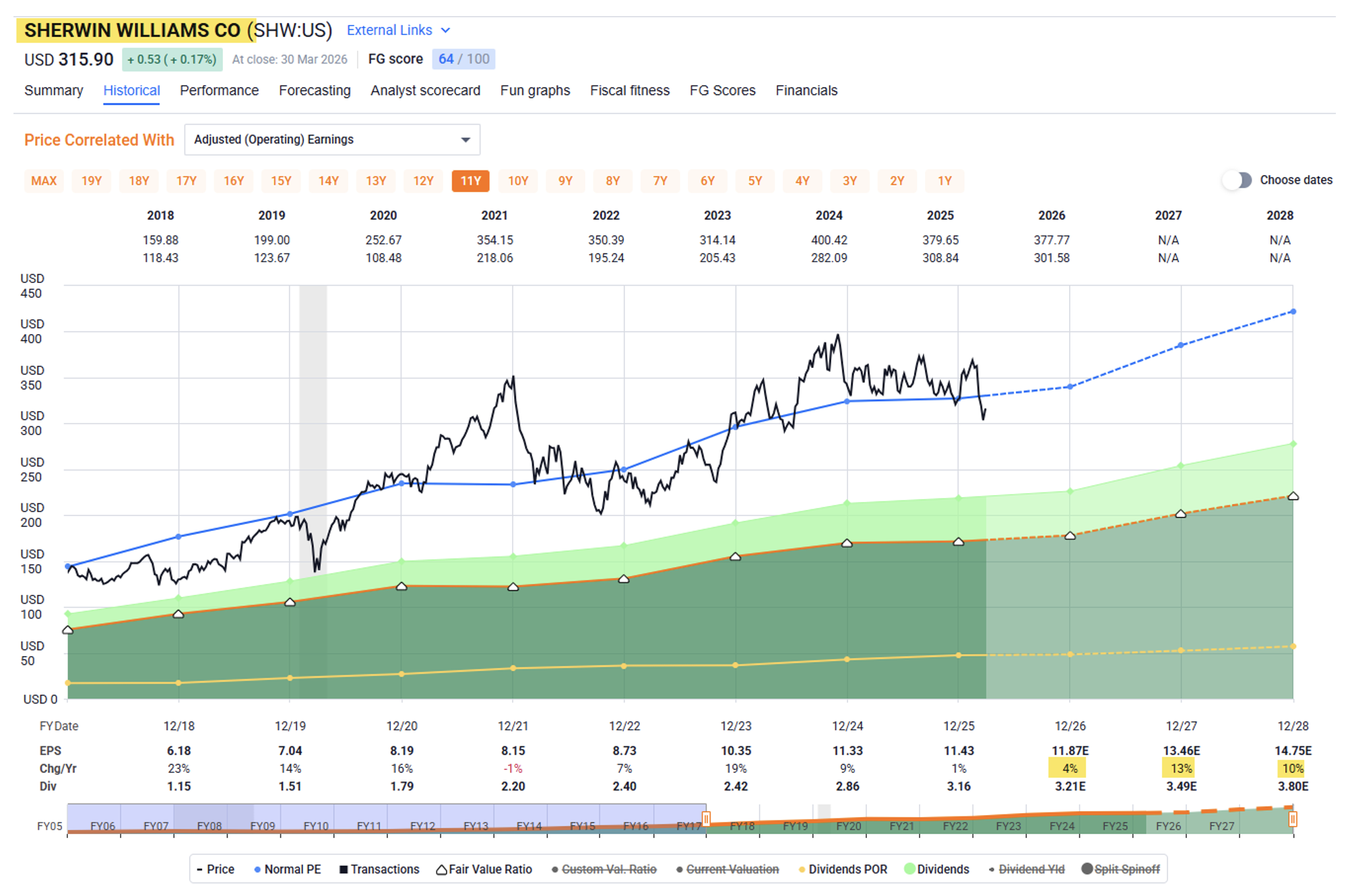
As shown below, shares are trading at $315.90. That means they provide a moderate – and rare – discount compared with their fair-value price of $330.
Analysts expect modest growth of 4% this year and more normalized growth of 13% in 2027. And while SHW’s dividend yield is just about 1%, I expect shares to return around 18% over the next 12 months.
In which case, now isn’t a bad time at all to buy some shares of this ultra-reliable company.
It’s far from flashy as stocks go. But it’s excellent at what it does, and its many shades of green (among others) just keep paying off.
In a world obsessed with quick trades and flashy trends that can lose favor permanently at the drop of a hat, I’m happy sticking with timeless brands that provide modest discounts during turbulent times like this…
With every indication of bouncing right back in short order.
Regards,
Brad Thomas
Editor, Wide Moat Daily
|