More than 1.5 million.
That’s how many people were affected by Verizon’s (VZ) service outage last week, which it attributed to a software problem. Though that’s nothing compared with AT&T’s (T) failures on February 22, 2024, which impacted a whopping 125 million devices.
Very few of us spend time thinking about the vast network of infrastructure required to make wireless networks possible. That is… until it stops working.
It’s these kinds of episodes that have people so excited about satellite-based connectivity, especially through Elon Musk’s SpaceX venture… a company that may very well go public this year in a $1.5 trillion IPO, as I mentioned earlier this month.
If it does, it will be the largest market debut we’ve ever seen.
While SpaceX’s biggest goal is to colonize Mars, it also has an Earth-oriented arm called Starlink. This operation seeks to provide truly global broadband Internet, reaching even remote locations around the world, through thousands of small satellites in low Earth orbit (“LEO”).
Starlink currently serves more than 9 million customers, a number that keeps growing. And its capabilities keep expanding as well. While it isn’t perfect yet, experiencing minor weather-related interruptions at times, it’s still exceptionally powerful. I’ve heard people speculate that this technology could one day put the cell carriers out of business.
But that won’t happen any time soon, and there’s one big reason why.
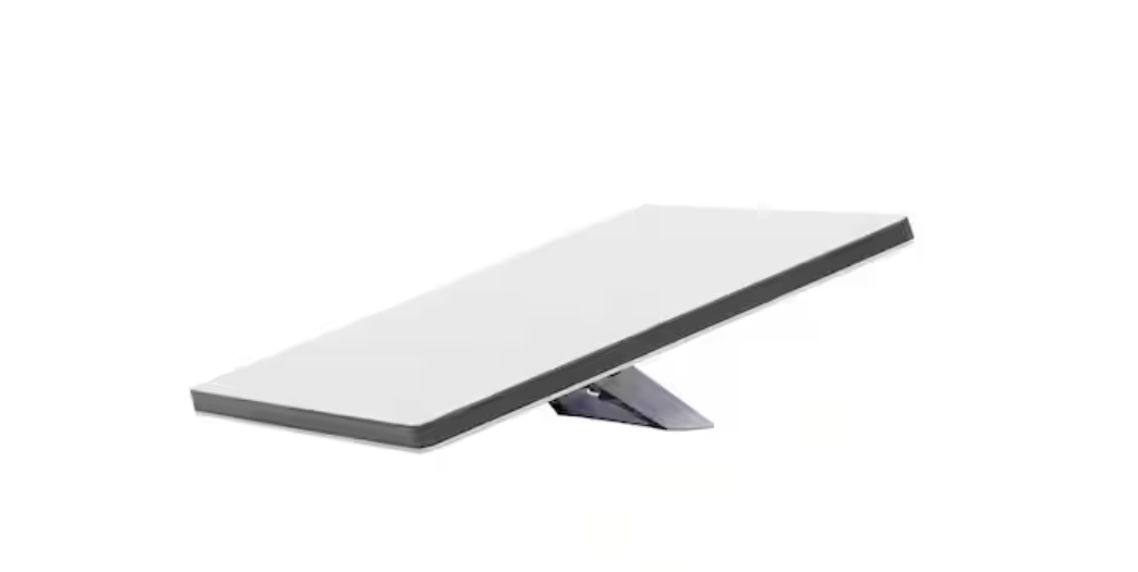
In order to operate, Starlink needs one of these:
Source: Starlink, Home Depot
That’s the Starlink Mini Kit. The company also sells full-sized versions that can be permanently attached to structures. Think of it as an advanced satellite dish.
It might be a great option for rural homes, recreational vehicles (“RVs”), or ships at sea. But unless millions of people begin to carry one of these around and set it up facing the sky every time they want to make a call, then the wireless carriers aren’t going anywhere.
The truth is that companies like AT&T and Verizon still have one heck of a wide moat – billions of dollars’ worth of wireless architecture and a mountain of regulation awaiting any would-be competitor.
The same can be said for cell-tower real estate investment trusts (“REITs”). These entities make money even when their “tenants” lose it from outages like the one we saw last week.
Better still, they pay you dividends while they do.
The Short but Intriguing History of Cell-Tower REITs
Cell-tower REITs were classified as a property category in the early 2010s. That’s when the IRS decided that cell towers – those tall structures wireless providers hang their equipment on – could be considered landlords renting out space to tenants.
As such, they could accept the REIT structure that allows them to pay no annual income taxes, instead distributing at least 90% of that money to shareholders in the form of dividends.
The first cell-tower company to make the switch was American Tower (AMT). Formed in 1995 as a unit of American Radio, it spun off on its own three years later when its parent company merged with CBS (CBSA).
American Tower elected REIT status in January 2012, and several competitors followed in short order. Today, four exist, with Crown Castle (CCI), SBA Communications (SBAC), and Uniti (UNIT) rounding out the sector.
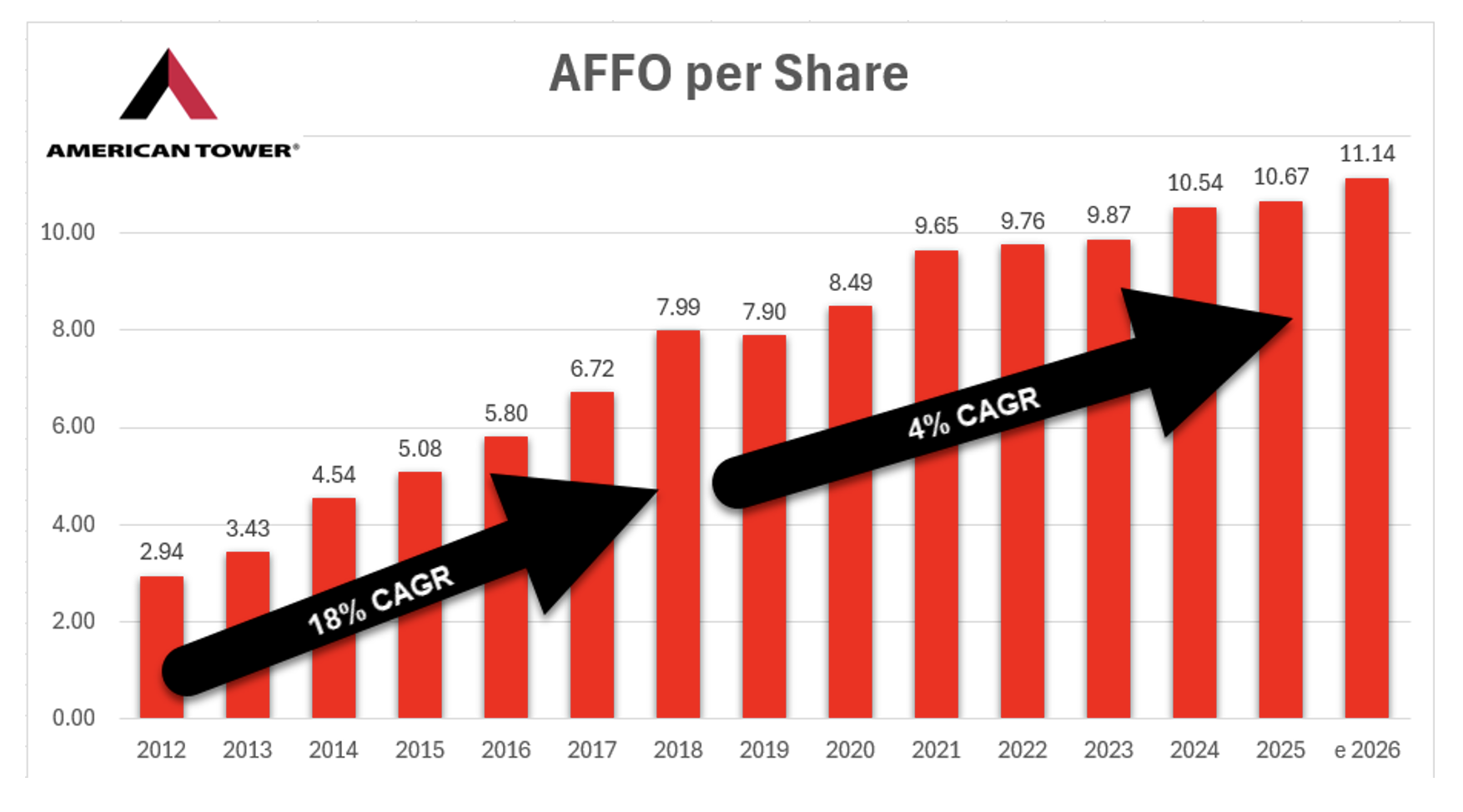
AMT in particular generated an 18% compound annual growth rate (“CAGR”) for its bottom line from the spin through 2018. Its dividend also increased noticeably at 20% CAGR during that same period, and shares returned an average of 15.6% annually.
In fact, it and its competitors averaged returns of 35.4% in 2017, the highest of any other REIT sector that year.
But that growth began to slow from there. American Tower’s adjusted funds from operations (“AFFO”), the REIT equivalent of earnings, grew by just 4% CAGR from 2018 to 2025, despite its best efforts.
Source: Wide Moat Research
There were a lot of expenses to account for during this time, admittedly. Recognizing that 5G would require new antennas and equipment on towers, cell-tower REITs began increasing the density of their networks by adding more sites through new towers, rooftop installations, and small cells.
Fortunately, those efforts are beginning to pay off. Mid-band 5G layered onto existing macro towers – with mmWave as a niche add-on – are turning 5G into a real growth driver for tower REITs. Though that’s not the only card some of them are playing.
AMT Takes Connectivity One Step Further
In 2019, American Tower acquired Colo ATL, a traditional data center in Atlanta. The following year, it launched its Edge Data Center initiative, deploying several small-edge facilities at or near its tower sites in cities like Denver, Colorado; Pittsburgh, Pennsylvania; Atlanta, Georgia; Jacksonville, Florida; and Austin, Texas.
And if you don’t know how profitable data centers can be by now, you have to read my recent findings right here. Suffice it to say that these properties are the backbone of the artificial intelligence (“AI”) build-out.
Without data centers, AI can’t exist.
American Tower saw this coming. The company bought in further in 2021 with its CoreSite Realty purchase for about $10.4 billion. This gave it a significant national portfolio of carrier-neutral data centers across major U.S. markets… transforming it into a meaningful player in the colocation/wholesale data-center space.
Better yet, AMT has maintained a disciplined capital structure along the way. As of the third quarter of 2025, it has net leverage of 4.9 times, with $10.7 billion in liquidity. And in the second quarter of 2025, it distributed $3.2 billion in dividends, had $1.5 billion in capital expenditures, and spent around $600 million on data centers.
Now, you may have heard about the ongoing disagreement involving Dish Network. Last September, that company (owned by EchoStar) sent a letter to American Tower alleging that it’s excused from its contractual obligations – despite that contract running through 2036.
AMT CEO Steven Vondran addressed this on the third-quarter earnings call, explaining how, “We filed a declaratory judgment action to ask the court to confirm that we own the remainder of the rent under that agreement.” And Dish has continued to make payments in the meantime regardless.
But even if things don’t end in the REIT’s favor, it won’t be the end of its world. The Dish agreement represents just 2% of AMT’s total property revenue ($200 million of $10 billion). So, it’s not a dominant driver of revenue.
American Tower Is Trading Cheap
In terms of valuation, American Tower is trading at an attractive multiple of 17.2 times price-to-AFFO multiple. Its normal multiple is 22.6 times.
As the largest player in the tower sector with 149,000 sites (compared with CCI and SBAC’s 40,000 each)… AMT has a scale advantage that, in my view, means it should trade at a premium. And I think the market will remember that soon enough.
American Tower’s dividend yield is 3.7%, and it’s well-covered with a payout ratio of around 70%. Crown Castle’s, in comparison, is 4.7% – and that’s actually a step down from where it was before the company announced it was selling off its fiber and small cells business for around $8.5 billion.
This sale marks a strategic shift as the REIT seeks to focus exclusively on its tower business.
As for SBAC Communication’s dividend yield, it’s just 2.3%. But the company has boosted it by an impressive 35% CAGR from 2020 to 2025.
Really, I like all three tower REITs. But if you asked me to own just one? I would have to pick American Tower for its complementary data-center business – with approximately 13% year-over-year growth – and its robust leasing activity across the tower and data-center businesses.
According to the average consensus of 17 analysts, American Tower should grow by 4.4% this year. Assuming that’s true and that it narrows the valuation gap to a reasonable 19.8 times, shares could return 25% over the next year.
Your cell service might be spotty from time to time, but these cell-tower REITs have been nothing but reliable for decades.
Regards,
Brad Thomas
Editor, Wide Moat Daily
P.S. I’m on TikTok. And I just posted a new video where I focus more on cell-tower REITs. I had a little fun with it. See for yourself right here.
|