The real estate world lost a legend on Monday.
David Simon, president and CEO of Simon Property Group (SPG), died at age 64. Despite his battle with cancer for the past two years, his family said he passed away peacefully.
He is now succeeded by his oldest child, Eli, who has some very big shoes to fill. Fortunately for the younger Simon, I’m confident he’s well prepared for the role. That’s just who his father was – a man who believed in proper preparation, quality, and building a legacy worth talking about.
David Simon didn’t found the company that would one day be called Simon Property Group. That was done by his father, Melvin, in 1960. It was a pursuit that quickly turned into a family venture with his brothers called Melvin Simon & Associates (“MSA”).
Starting in Indianapolis, Indiana, they built up a small kingdom of strip malls and retail shopping centers with reliable anchor tenants. From the very beginning, the Simon clan wanted nothing but the best properties in the best locations.
MSA opened its first enclosed mall, University Mall, in Fort Collins, Colorado, in 1964. I don’t know if the Simons had any idea back then that this type of structure would become its bread and butter, but it was a portentous move, nonetheless.
In 1975, they made another mall milestone with the construction of Town East Square in Wichita, Kansas – their first indoor mall with more than 1 million square feet of space. And by the early 1990s, they owned a total of 147 shopping centers of various sizes across 30 states.
That all helped them go public in December 1993, marking the biggest real estate investment trust (“REIT”) IPO of its time by raising almost $1 billion.
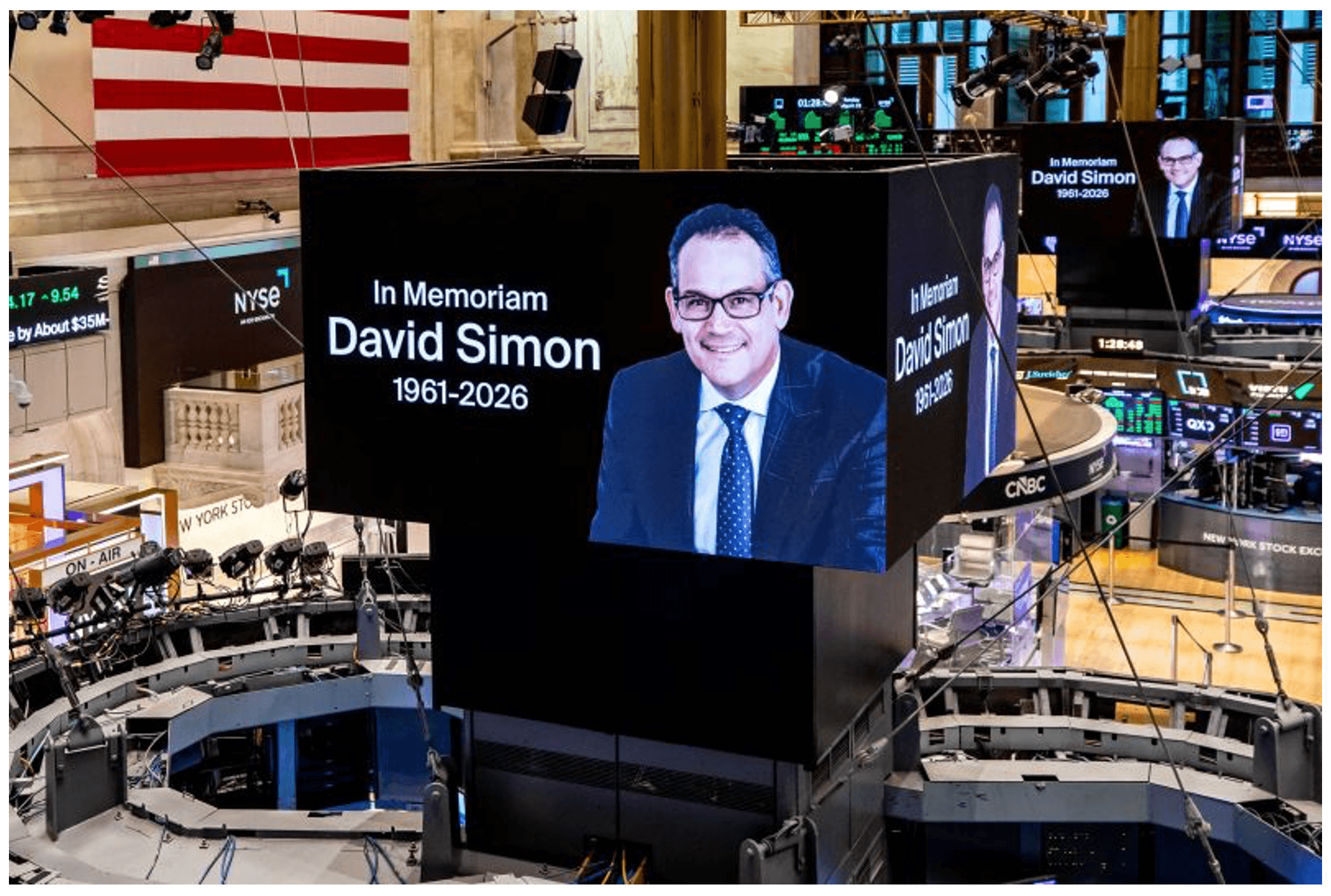
Source: NYSE (LinkedIn)
David Simon would go on to honor his father’s legacy through thick and thin… creating an absolute fortress with a moat so strong and deep it could survive the dawn of the century up ahead.
The E-Commerce Years
David Simon took over as CEO in 1995 when he was just 33, guiding the company through an enormous merger with DeBartolo Realty the very next year. The resulting REIT, Simon DeBartolo Group (which went on to become Simon Property Group (SPG)), was a North American empire that became even bigger in 1997 with the purchase of the Retail Property Trust and then Corporate Property Investors in 1998.
It was a business built to last… even through the insanity of the next two and a half decades.
We all know how rough the 2008 crash and subsequent Great Recession were on real estate. Yet Simon Property Group made it through to become bigger and better than ever.
But the real challenge would be e-commerce, which was gaining rapid adoption in the early 2010s. Online shopping was encroaching on the traditional shopping experience at an accelerated rate.
Black Friday – the day when retailers traditionally broke out of the red – was losing ground year after year to Cyber Monday. Some analysts were predicting the complete collapse of malls.
Yet David Simon didn’t back down for a minute.
If anything, he doubled down, making more strategic purchases across not only North America but Europe and Asia as well. At the same time, he continued to add value to existing properties.
Simon never lost faith in the mall experience, realizing early on that traditional shopping wasn’t the issue. Touching, feeling, and, yes, smelling products, too (hello, Bath & Body Works), pre-purchase was still important. Likewise, the socializing aspect of shared retail space remained pertinent as well.
It was only that retailers had gotten complacent, growing lazy in their planning and execution, and taking their customers for granted.
So, Simon set out to show his shoppers that they were still valued, adding luxury elements like high-end restaurants, gyms, hotels, and entertainment venues to existing properties. Simon Property Group became exceptionally selective in its tenant choices. The Simon properties weren’t just a disparate collection of retail shops. It was a retail community worth participating in.
He did all this while amassing a total portfolio of more than 200 million square feet. But the real test of its durability came in 2020.
Through COVID-19 and Beyond
Everything David Simon did to stay relevant in the 2000s and 2010s came in handy once 2020 came around.
So many stores were already struggling. The “retail apocalypse” was already well on its way. And then the shutdowns happened. Every single one of Simon’s carefully planned and executed experiential assets was “locked down.”
Like almost every other publicly traded brick-and-mortar company on the planet, SPG plummeted. And to live another day, its battle-tested CEO did make the difficult decision to cut its dividend.
I’ll admit that surprised me at the time, but it was the disciplined move. As major tenants like Brooks Brothers and JCPenney slid into bankruptcy thanks to months of lost revenue… Simon used the money it had saved to buy them up.
Everyone second-guessed (or flat-out trash-talked) those moves. Yet, once again, he doubled down on them. Aeropostale, Nautica, Forever 21, Lucky Brand, Eddie Bauer… David Simon bought up stakes in all of them to keep his larger business afloat.
And it worked.
Despite all the naysaying and outright mockery from outsiders, it actually worked.
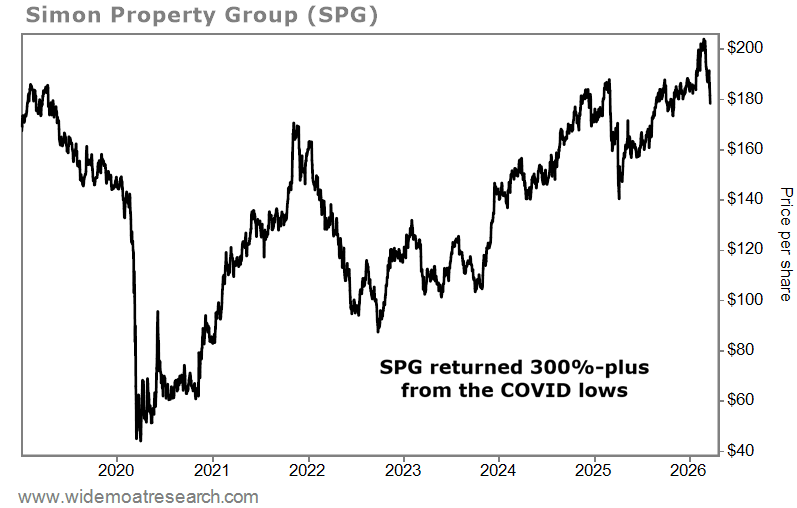
After collapsing nearly 70% during the COVID-19 crash of March 2020, shares of SPG began a remarkable recovery. Anybody who followed David Simon during those dark days was rewarded with a total return north of 300%.
Do you know what else worked? David Simon’s omnichannel efforts to stay relevant even in the face of lingering agoraphobia after 2020. Recognizing reality, he worked with e-commerce trends instead of against them – while still acknowledging the basic human need to get out and interact with the world.
-
As such, while still investing in making Simon’s physical malls the places to be, the company also set up:
-
ShopSimon.com, a digital marketplace
-
Simon Search, a real-time, in-depth mall inventory app
-
Simon+, a loyalty program designed to reward shoppers, tenants, and itself all at once.
The result of all these efforts was quick and clear. As David Simon explained in the company’s 2022 annual report:
I am really pleased with our 2022 results on how we have positioned Simon Property Group… We have fully bounced back from the toll of the Covid-19 pandemic. Retailer demand is strong. Our properties are getting better, excess supply is leaving the landscape, and e-commerce growth has decelerated as retailers acknowledge that it is simply not as profitable as physical stores… This is leading to growth in our property cash flow.
How many mall landlords could claim the same back then? Or even now?
A Tough Act to Follow
Will Simon Property Group continue to thrive after the tragic and untimely loss of David Simon?
Longtime readers will know how crucial company management is. I wrote an entire chapter on the topic in The Intelligent REIT Investor Guide.
That segment begins by reminding readers of the saying, “Bet the jockey, not the horse,” which “refers to the idea that investors should focus more on the management team than the business model.” And it’s immediately followed with:
I consider the adage to be quite true, especially in REIT-dom, where management teams are responsible for all the obligations of being a landlord – from finding a tenant to collecting the rent, taking care of repairs, and maintaining the balance sheet – and, of course, sending distributions (i.e., dividends) to investors. Stated bluntly, bad management can destroy value in a portfolio of real estate properties. Good management can add value.
As I also wrote, “That’s why I spend a lot of time meeting with C-suite executives, always looking for information to help me form a deeper understanding of the underlying investment strategy – and whether it allows my goals to be aligned with theirs.”
I look forward to doing the same with Eli Simon as soon as possible. But until then, keep in mind that the legacy his father first inherited and then expanded is one of commitment, long-term strategy, and ingenuity.
Having met the late Simon more than once, I know he was a family man who worked hard to raise responsible children. He was a businessman who worked hard to keep his company intact.
I’ll be watching Simon Property Group closely from here, but I have a strong sense that David’s vision is safe with his son in charge.
Let’s see what he can do.
Regards,
Brad Thomas
Editor, Wide Moat Daily
|