Let’s talk about Kevin Warsh, President Donald Trump’s Federal Reserve chair nominee.
This past Friday, January 30, Trump posted on Truth Social:
I am pleased to announce that I am nominating Kevin Warsh to be the CHAIRMAN OF THE BOARD OF GOVERNORS OF THE FEDERAL RESERVE SYSTEM… I have known Kevin for a long period of time, and have no doubt that he will go down as one of the GREAT Fed Chairmen, maybe the best.
That’s high praise, to be sure. Then again, Trump said very nice things about current Chair Jerome Powell back when he nominated him in 2017. That relationship has since soured… and that’s putting it mildly.
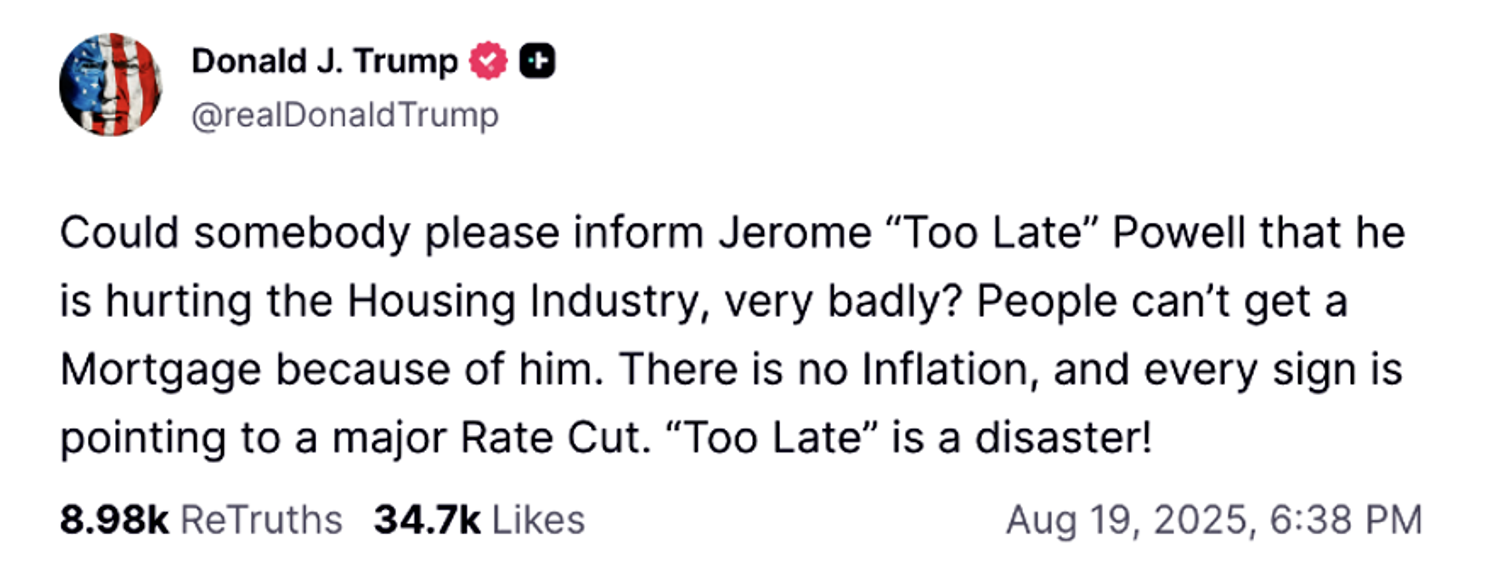
Source: Truth Social
Despite the president’s insistence that interest-rate cuts continue, Powell declared (also on Friday) that they were being paused. No word on how long that break will last, either, since he said:
We’re not trying to articulate a test… for when to next cut or whether to cut at the next meeting. What we’re saying is we’re well positioned as we make decisions meeting by meeting, looking at the incoming data, the evolving outlook, and all that. And we’re in a position where… we still have some tension between employment and inflation, but it’s less than it was. I think that the upside risks to inflation, the downside risks have probably both diminished a bit.
Powell has never given any impression he’s interested in playing politics. Still, I can’t help but wonder if pausing rates right as Trump wants them lowered made him chuckle a bit.
The assumption was that Trump had learned his lesson and would nominate a man who would go along with whatever he wants, which means lower rates. And if that was the thinking, then Warsh is an interesting (perhaps even surprising) nomination.
A Fed Critic Running the Fed
Hardly new to the Fed’s ins and outs, Warsh served on the board of governors from 2006 to 2011. Appointed by President George W. Bush, he was only 35 years old when he took the job, making him the youngest person to do so.
Warsh went all-in on helping design and implement emergency programs during the Great Financial Crisis… including the highly controversial quantitative easing, or QE. At a high level, the program allowed the Fed to directly buy assets, mostly Treasurys and mortgage-backed securities. This flushed the system with liquidity, forced down rates, and generally served as a shot in the arm for stock prices.
That has led some to assume Warsh is all in on Trump’s “boom, economy, boom” priorities. But there’s a lot more to the Warsh story than his QE legacy.
He actually came out against QE2 in 2010, even with 9.8% unemployment plaguing the country. He even argued before Congress that the Fed was overplaying its authority over the economy in ways that would ultimately hurt it.
In 2016, he called out the Fed for its role in exacerbating wealth inequality. From The Wall Street Journal:
[The Fed] expresses grave concern about income inequality while refusing to acknowledge that its policies unfairly increased asset inequality.
In 2018, he criticized the Fed for being complacent:
The most consequential period in economic policy is often when the embers of the last fire are gone and the first sparks of the next are not yet visible. Policy makers should not be dismissive of less likely, but more damaging tail events.
And in 2023, on the Fed’s role in inflation:
History will give a full accounting of the grave errors committed in recent years in economic policy. A central lesson is already clear: Nothing is as expensive as free money.
That all sounds decidedly hawkish. But Warsh is not dogmatic. He also criticized the Fed for dragging its feet on cutting interest rates last summer.
The one common denominator with Warsh seems to be that he’s a Fed critic. That makes it a bit ironic (or perhaps poetic?) that he’s likely to run the place soon.
Radical Thinking
By all indications, Warsh seems to be neither too worried about inflation nor too worried about employment.
On inflation, he feels that technology, specifically AI, rapidly increases productivity and can act as a check on inflation.
From a recent interview:
I don’t think the data will reveal these productivity gains [from AI] for many years after the anecdotes reveal them. What’s that Bezos quote? "If you have a set of data telling you one thing and a set of anecdotes telling you the other, listen to the anecdotes."
And on the topic of wages and employment, he was even more straightforward:
If we’ve learned anything in economics, it’s that productivity gains are the predecessor to wage gains. This is the most productivity-enhancing wave of our lifetimes.
This type of thinking is likely why he’s at odds with today’s Fed. Warsh has spent years now arguing against “the central bank’s models,” which “presume a tighter labor market must yield faster inflation. But those relationships appear tenuous at best.”
That’s pretty radical thinking, as far as central bankers go. But given all the Fed’s miscues and mistakes in recent years, maybe a radical is just what America’s central bank needs.
If Warsh becomes Fed Chair and is a man of his word in this regard… we could see a surge in smart companies having greater say in how their businesses grow. Markets under him will likely focus on a mix of:
-
Policy credibility
-
Inflation discipline
-
Lowered rates
And yes, rates will likely go lower. Many observers have noted his recent suggestions for rate cuts up to 200 basis points.
Regardless of how quickly or drastically cuts happen, these policies often push investors into dividend-paying stocks – including real estate investment trusts (“REITs”) – as bond yields decline.
Altogether, I view Warsh as a strong choice. And if his polices end up being a boon for the stocks we hold in our model portfolios, I won’t complain about that either.
Regards,
Brad Thomas
Editor, Wide Moat Daily
|