I was recently reminded of Warren Buffett’s famous speech to Masters of Business Administration students at the University of Florida in October 1998: the one where he emphasized one of his most famous principles…
“Don’t lose money.“
It’s a great line – one of many from the Oracle of Omaha. And I’m glad that’s what still stands out today after all these years.
Not the part where he put real estate investment trusts (“REITs”) through the verbal wringer, saying:
REITs have, in effect, created a conduit so you don’t get the double taxation, but they also generally have fairly high operating expenses.
… let’s just say you can buy fairly simple types of real estate at an 8% yield or thereabouts, and you take away close to 1% to 1.5% by the time you count stock options and everything. It is not a terribly attractive way to own real estate.
Maybe [that’s] the only way a guy with $1,000 or $5,000 can own it. But if you have $1 million or $10 million, you are better off owning the real estate properties yourself instead of sticking some intermediary in between who will get a sizable piece of the return for himself.
Buffett wasn’t finished, adding:
REITs have behaved horribly in this market, as you know. And it isn’t at all inconceivable that they become a class that would get so unpopular that they would sell at significant discounts from what you could sell the properties for.
Moreover, even if they did improve as a class, he wondered, “whether management would fight you in that process because they would be giving up their income stream for managing things and their interests might run counter to the shareholders on that.”
Later this week, I plan to highlight several of the most important lessons Buffett has given us over the years (along with some of my own lessons learned).
But this REIT rebuke?
This wasn’t one of them. In fact, Buffett himself went on to recognize the error of his ways.
Berkshire’s Billboard REIT Bet Is Paying Off
Some of you may remember my August 2025 article titled, “Buffett Bets on Billboards.” In it, I reported how his Berkshire Hathaway (BRK-A)(BRK-B) had just disclosed its investment into Lamar Advertising (LAMR).
Lamar is a REIT. A billboard REIT, to be specific.
Most anyone who drives along major thoroughfares throughout the U.S. has seen its signage towering above the landscape. Those ads direct you to the Chick-fil-A or McDonald’s at the next exit… a lawyer you can call if you’ve been hurt at work… or a jeweler at the outlets 20 minutes down the road.
Lamar has been in the billboard business for more than 100 years now, so it obviously has some staying power. And Berkshire recognized that in the second quarter of 2025 by buying up 1,169,507 shares and then again in the third quarter of 2025 with another 32,603.
Since that first purchase, Lamar has returned around 14%, outperforming the Vanguard Real Estate Index Fund (VNQ), a fairly reliable REIT benchmark.
That wasn’t the biggest purchase Berkshire ever made, of course. But it did mark a major shift in attitude toward REITs.
Nor was it Buffett’s first foray into REITs. His holding company purchased shares in Seritage Growth Properties (SRG), a spinoff from Sears, in 2015. That was a special sort of situation, admittedly, but it was still holding shares.
And in 2017, Berkshire bought a sizable 18.6 million shares in STORE Capital (formerly STOR), a prominent mall REIT that was publicly traded at the time. It then backed the truck up on that decision in the second quarter of 2020 – at the heart of the COVID-19 lockdowns – with another 5.79 million shares.
Could we see more REIT purchases from Berkshire? That’s what I’m wondering, especially now that Buffett has stepped down and there’s new management at the helm.
The ‘Youth’ Factor
Mere weeks ago, on New Year’s Day, Warren Buffett made history by stepping down from managing Berkshire Hathaway’s day-to-day operations… 60 years after he first accepted the CEO role.
Everyone knows the legend he has become, the money he has made, and the wisdom he has provided. But even the best races have to come to an end eventually, and sometimes they need to.
Buffett, who is still chairman, can probably use a bit of a break. He is 95, after all.
Not to say that his successor, Greg Abel, is a spring chicken at 63. One of Buffett’s key lieutenants for the past 25 years, he has been instrumental in acquisitions such as MidAmerican Energy – now Berkshire Hathaway Energy – and overseen important aspects of many other company holdings.
But that combination of experience and comparative “freshness” is probably precisely what a well-established giant like Berkshire needs in a world of artificial intelligence (“AI”), cryptocurrencies, and other alternative investments.
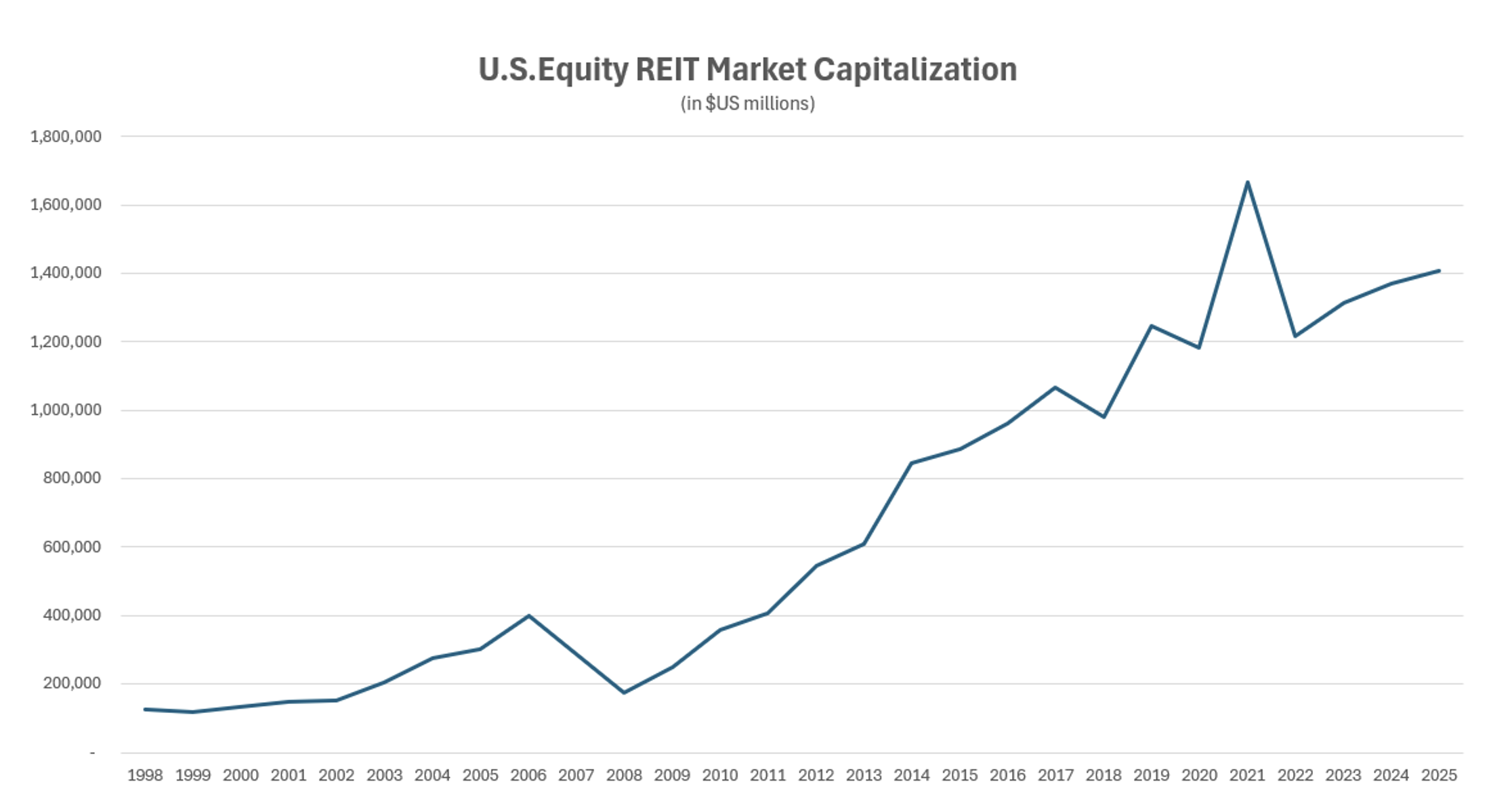
We’ve also long-since crossed the point of REIT profitability. When Buffett talked about them in that speech 28 years ago, the asset class was still in its infancy, with a market capitalization of around $126 billion.
It has since mushroomed to over $1.4 trillion, undeniably erasing Buffett’s prediction that REITs could “get so unpopular… they would sell at significant discounts.”
These real estate companies have also become their own broader investment universe. REITs were formally moved out of the financials sector under the Global Industry Classification Standard and into their own real estate sector in 2016. And they’ve added new categories like cell towers, data centers, farming, timber, and single-family rentals – which I wrote about recently.
Source: Wide Moat Research
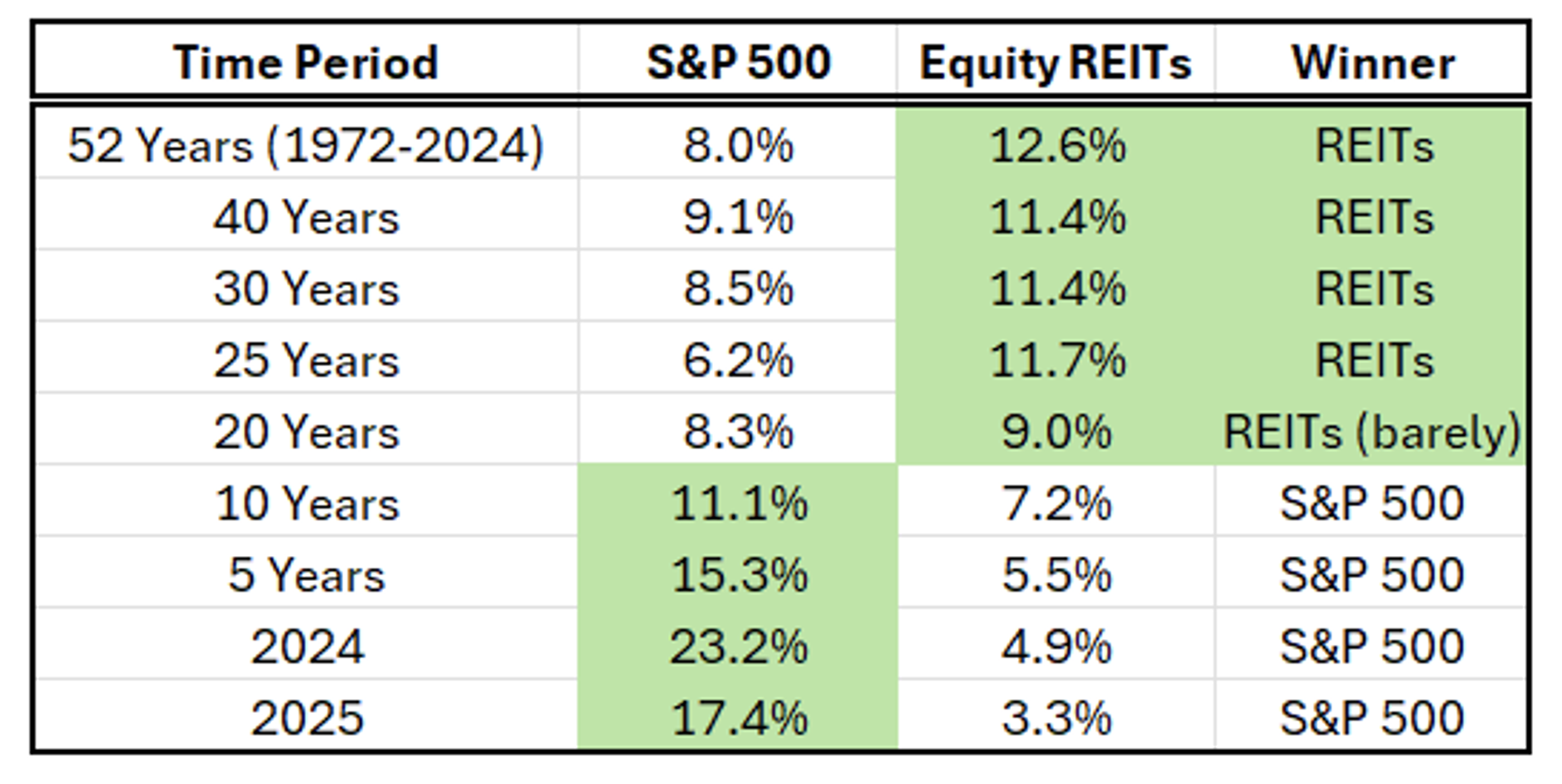
Better yet, over the past 30 years, REITs have delivered strong double‑digit average annual total returns of about 12% across the various subsectors. This places them among the top-performing major asset classes over multidecade periods.
In short, there are plenty of solid, safe, and growing opportunities. And Abel, who might very well have been behind last year’s Lamar purchase, is young enough to more readily forgive REITs their bumpy beginnings.
Source: Wide Moat Research
The Bottom Line
Regardless of what real estate decisions Berkshire makes from here, our team at Wide Moat Research remains laser-focused on REITs – the ones that enjoy durable competitive advantages. So we’ll keep meeting with management teams that create value for their companies, their clients, and their shareholders alike.
To reference Warren Buffett one more time, if you don’t “have $1 million or $10 million” to own “real estate properties yourself”… along with the proper knowledge, wisdom, and time to make that money count…
REITs really can be a great way to own real estate. I’m confident this year will showcase plenty of examples of how worthwhile they can be.
Regards,
Brad Thomas
Editor, Wide Moat Daily
|