
The big news is President Trump’s actions against Venezuela over the weekend. Everyone seems to have an opinion on it… and with good reason.
I’m still taking some time to evaluate the situation. I hope to share my thoughts later this week.
But, for now, let’s turn to another topic: Why 2026 could go down as a blockbuster year for initial public offerings (“IPOs”).
Collapse and Rebound
There’s always a big hoopla over new listings on major U.S. exchanges. IPOs are big moneymakers for the Wall Street banks. And investors tend to eat these listings up like candy.
But the market is especially hungry this year.
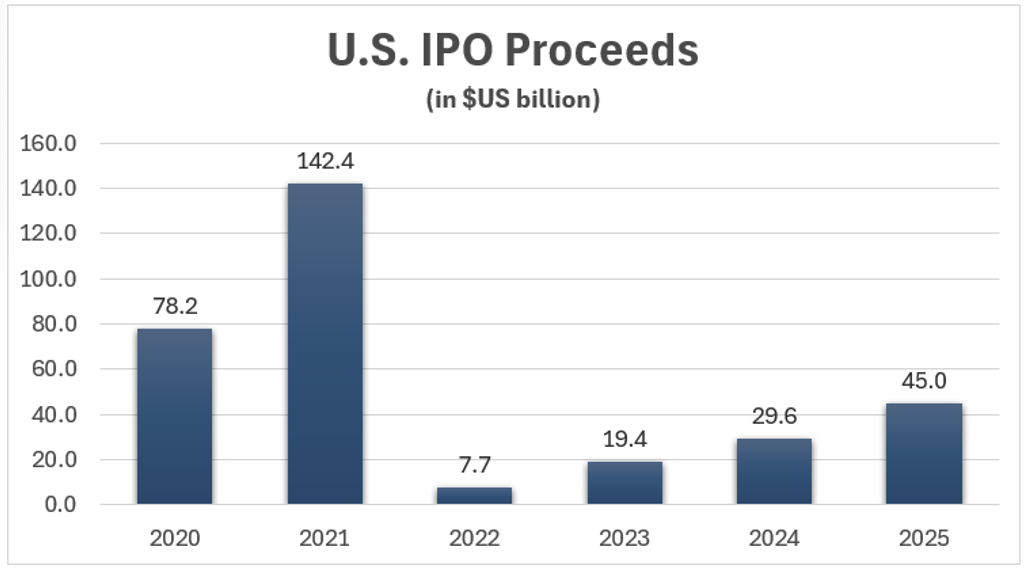
That’s because there has been a dearth of IPOs the past few years. Have a look below.
Source: Wide Moat Research, public data
2021 was a banner year for IPOs. IPO proceeds clocked in just north of $142 billion that year. That volume was driven by near-zero interest rates, of course. Not to mention companies that delayed making moves in 2020 due to all the uncertainty.
That was the year we saw electric-vehicle-maker Rivian Automotive (RIVN) raise $11.9 billion and Chinese mobility-tech platform DiDi Global raise $4.4 billion. There was also dating app Bumble’s (BMBL) $2.2 billion IPO and trading app Robinhood Markets’ (HOOD) $2.1 billion.
However, DiDi had to delist a year later after Chinese regulators took it to task. And Rivian settled on a $25 million class action lawsuit in October after it was accused of misstating important investor information.
Those are just two examples of why you have to be careful while navigating IPO hype. Because, far too often, there’s far too little market momentum left after that first trading day.
What should also stand out in the chart is the dramatic fall from the 2021 highs. With rates rising, stocks falling, and investor sentiment souring, IPOs for 2022 were a fraction of the year prior. But we’ve seen a steady rebound ever since.
U.S.-listed companies raised nearly $45 billion in 2025. That’s a meaningful rebound over 2022, 2023, and 2024, but it was still well below the $142.4 billion we saw in 2021.
More IPO Stories to Talk About in 2026
If you’ve followed Wide Moat Research for even a little while, you’re probably not surprised by my opinion on IPOs.
As I explained in an article last year, “In the absolute worst case, the IPO market can be a dumping ground once private investors feel there’s no more ‘juice’ left to squeeze. And so they foist the shares onto the public markets to make their exits.”
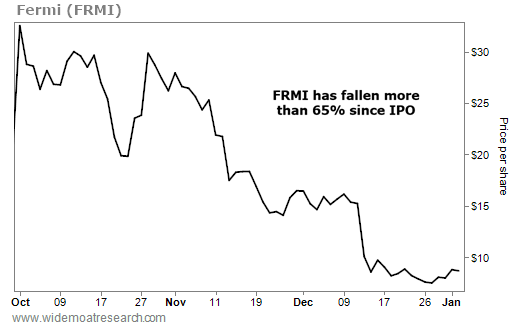
That’s why I recommended avoiding shares in Fermi (FRMI) back in October. The brand-new data-center real estate investment trust (“REIT”) – which had no operating assets and therefore no profits yet – listed shares at $21, only to see them skyrocket to an even more unreasonable $32.04 by the end of that first trading day.
Hype alone only lasts so long, though. Reality quickly set in, sending the stock down. As of Friday’s close, it was sitting at $8.82.
Source: Yahoo Finance
Fermi might be one of the most drastic examples of IPO regret. But it’s not alone as a disappointment among the 300-plus IPOs the U.S. saw last year – including blockbuster technology companies like Sailpoint (SAIL) and Figma (FIG), and financial tech (fintech) players such as Circle Internet (CRCL) and Bullish (BLSH). All of them are down from their post-IPO highs.
As for what might be coming out of the gate this year…
There’s Anthropic, an AI research and safety company focused on large language models (“LLMs”) and AI systems. It has engaged legal advisors to begin the IPO process, and they’re pursuing a $300 billion valuation.
That’s pennies compared with ChatGPT competitor OpenAI, however, which is eyeing a $1 trillion valuation. And while it might wait until 2027 to go public, investors are already drooling.
Yet even that astronomical assessment pales against speculation surrounding Elon Musk’s SpaceX. Founded in 2002 with a core mission to reduce the cost of space travel and enable the colonization of Mars… it could raise as much as $1.5 trillion if it IPOs the way its eccentric leader has been teasing at.
And then there’s one more potential IPO worth paying attention to.
Fannie and Freddie Return
Fannie Mae and Freddie Mac might be coming back.
To be clear, both do technically trade over the counter (“OTC”). But that doesn’t mean they’re public companies… at least not in any way that matters.
Both were placed under government conservatorship in 2008. That means shareholders have effectively no control over either company. There are no dividends. And any profits are swept up by the U.S. Treasury. The stocks have gone basically nowhere since the financial crisis.
But that might be changing.
Some investors, such as billionaire hedge-fund CEO Bill Ackman, have suggested selling a portion of each to release them from conservatorship.
That got plenty of people salivating, and I understand why. As President Trump said last year, both companies are doing “very well” and “throwing off a lot of cash.”
Just keep in mind that, given its political and regulatory factors, this would be more complex than a traditional listing. And it would require overt action from the federal government.
But even if it – or even OpenAI – doesn’t list anytime soon, 2026 is bound to be a banner IPO year as rates continue to decline… the market continues to rise… and technology advancements continue to dominate the investment conversation.
But that doesn’t mean I’m recommending readers rush out to buy whatever ends up being the hottest IPO this year.
The Strategy I Like for 2026
As I showed above, many of the favorite offerings from last year are now trading well below their post-IPO highs. As a general rule, we like to see a company prove itself in the public markets before we consider recommending it. And that’s why I’m unlikely to recommend any IPOs this year.
I like to stick with well-established businesses that have years’ worth of data we can sink our teeth into. And one of my favorite areas right now is data centers, the mission-critical infrastructure that powers many of the companies mentioned above.
These physical facilities provide highly specialized space where giants like ChatGPT, SpaceX, and DataBricks can all process and store the information they collect.
Even if these tech IPOs fall hard out of the gate, they’ll still keep paying steady “rent” checks to their data center landlords. I don’t know about you, but I’ll settle for that kind of sustainable growth any day.
You can learn more about some of my favorite data center investment ideas right here.
Regards,
Brad Thomas
Editor, Wide Moat Daily
|
