Apple Inc.
1 Apple Park Way
Cupertino, CA 95014
Attn: Timothy Cook, Chief Executive Officer
Dear Mr. Cook:
My name is Nick Ward. I am a direct and beneficial shareholder of Apple (AAPL) common stock, a position I have held for over a decade.
The investing world recently learned that you will be stepping down from your current position effective September 1, 2026, and transitioning to executive chairman of the board.
On behalf of myself and all Apple shareholders, allow me to thank you for your hard work, business acumen, and all the wealth you helped generate for my family and me.
After such a tenure, you are undoubtedly receiving numerous letters of thanks and congratulations. Allow me to add my small contribution to the pile.
My first couple of jobs out of college weren’t glamorous. My studies at the University of Virginia were largely focused on modern American poetry. I could tell you everything that you’d need to know about people like Gary Snyder or Jim Harrison. However, at the time, I knew nothing of finance.
Coming out of the Great Recession, the job market wasn’t exactly hot for humanities majors. So, I worked as a parking lot attendant. It was a cool job. I got to sit in a little grungy booth all day and night, reading, writing, and eating free take-out.
My pay was paltry, but at least it paid my rent. For a while, I was content. I thought I’d sit in that booth and eventually write the next great American novel.
I tried. And failed. And it didn’t take me long to realize that if I wanted to get ahead in life, I’d need to find other ways to grow my bank account.
That’s when I added authors like Benjamin Graham, Warren Buffett, and Peter Lynch into my reading repertoire. I started reading The Wall Street Journal. And eventually, I stumbled across an online community of investors and retirees who swore by the power of compounding associated with dividend growth investing.
I never looked back…
It didn’t take me long to realize that the stock market can be highly irrational in the short term. That volatility could play tricks on even the most discerning investor. However, I realized that if you knew where to look, stable and consistent growth was there for the taking.
My mentors taught me that the underlying fundamentals (sales, earnings, cash flows, etc.) that allow companies to pay reliably growing dividends over time are the very same things that propel share prices higher over the long term.
There was a problem, though. I didn’t have much money.
At first, I bought shares of companies like Coca-Cola (KO) when I could scrounge up some extra savings. I heard phrases like “investing in a marathon, not a sprint” countless times back in those early days. I knew the best thing I could do for my wealth, long term, was to buy shares of blue-chip dividend payers and reinvest the income.
But I wasn’t content with the high-single-digit growth rates associated with most of the dividend growth stocks that came across my radar.
I had no doubts that the traditional dividend growth approach would make me a rich man… eventually. But eventually can mean decades.
I had dreams of returning to writing. And, so, I would need to find investments that could speed up the process of compounding through market-beating returns.
That’s how I became a shareholder in your firm, Apple (AAPL).
No Brainer
With the benefit of hindsight, Apple appears to have been a no-brainer investment in the early 2000s, as you know very well. You were chief operating officer of the company during the transformative years of the iPod and iPhone. You even made a small cameo during Mr. Jobs’ reveal presentation of that first smartphone.
But as I began my investing journey around 2011, Apple had plenty of naysayers. The stock was “too big,” they said. Just before you took over as CEO from the legendary Steve Jobs, the firm was already the world’s largest company with a market capitalization of some $300 billion.
But to me, this was never a problem. On the contrary, I’ve always thought that bigger was better. When investing, I always wanted the best. The biggest sales figures, the biggest earnings, the biggest cash flows. Why should a company be the victim of its own success?
Another common critique was that Apple was a “one-trick pony,” in reference to the iPhone’s dominant presence in revenue generation. Something, the critics argued, would knock the iPhone off its perch.
These “risks” notwithstanding, I purchased shares near the beginning of your tenure as chief executive officer. And I’m glad I did.
With a market capitalization of approximately $4 trillion, the firm has grown in value by some 1,233% over your tenure. And far from being displaced, the iPhone is as ubiquitous as ever, with some 58% of American smartphone users opting for your product. And this is to say nothing of the numerous new product offerings you released over the past 15 years.
The Ground Floor
Mr. Cook, all this strikes me as ironic. Many assumed you were destined to fail. Mr. Jobs’ shoes were just too big.
Mr. Jobs was undoubtedly a genius. However, I applaud you for never trying to replace him. Instead, you doubled down on Apple’s promise to consumers to produce the best products. You sought to further monetize them via the app store. In so doing, you transitioned Apple from a hardware pure-play into one of the world’s largest Software-as-a-Service companies. And you used the firm’s massive cash hoard to return money to shareholders.
Looking back over your numerous accomplishments, two stand out to me in particular.
The first is the task of vertically integrating Apple’s supply chain. That may not seem “exciting,” but the subsequent operation performance speaks for itself. I believe you will also be remembered as one of the most generous CEOs – in terms of shareholder returns – that ever lived. Over your tenure, you returned more than $1 trillion to your shareholders through dividends and stock repurchases.
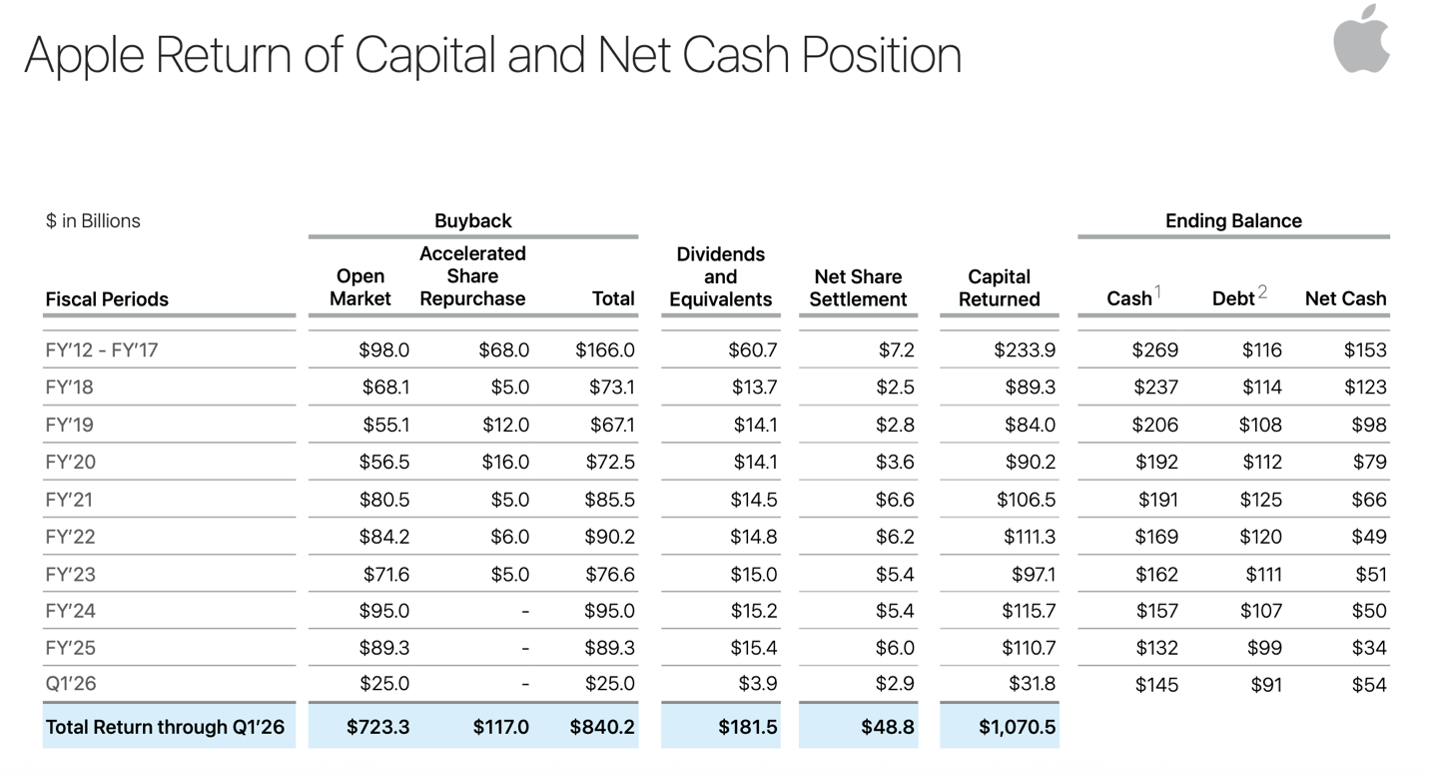
Source: Apple Investor Relations
I began acquiring shares shortly after Apple’s announcement of a common stock dividend in 2012. Did most people think of Apple when they thought of dividend growth stocks back then?
No, they did not.
But after a double-digit dividend raise in 2013 and a sell-off that pushed Apple’s dividend yield up above the 2% threshold, I was happy to buy more shares. With more than $200 billion in cash on hand, I assumed that future increases were on the way. I decided I didn’t need to wait for Apple to establish itself as a reliable dividend grower. Instead, I’d get in on the ground floor.
I still own those shares today, Mr. Cook. In fact, I have added opportunistically to the AAPL position whenever the market irrationally punished the stock.
Not only has the stock become a 10-bagger for me personally, but the firm has not missed a dividend increase since I began buying. Eventually, I believe your company will achieve the status of “dividend aristocrat.”
My proudest moment, regarding Apple stock was probably during the first quarter of 2016 when Warren Buffett bought a massive stake in the company. Back in those days, I was someone who followed Buffett into investments. But, in this case, I beat him to the punch.
That moment changed how I thought of myself as an investor. It gave me the confidence to go against the grain and make high conviction investments. I proved to young Nick that he knew what he was doing. In a way, that confidence boost launched the career that I have today.
Apple is no longer the largest holding in my portfolio, but it remains the one investment I have the fondest memories of. In large part, I have you, Mr. Cook, to thank for that.
I wouldn’t be here without you, Mr. Cook. And for that, I wish to truly thank you for your dedication to shareholders. I wish you a happy retirement and look forward to the tenure of Mr. Ternus.
Kind regards,
Nick Ward
Analyst, Wide Moat Research
|