Around 6:30 p.m. on Tuesday, I received a text from a friend…
“Hey, on Robinhood, if you’re trying to sell a stock, can you do it after the close of business?”
John (I’ve changed his name) followed up with several frantic questions about capital gains taxes, high-yield savings accounts, and the war in Iran.
As it turns out, John was very concerned with the war. He’d been exhausted by the headlines. He’d seen the value of their stock portfolio fall throughout the past month or so. And ultimately, he decided to sell stocks, avoiding more losses, and lock in profits (which had shrunk since the start of the year).
John had a new plan: Stash the cash in a “much safer account.”
John is not alone. Plenty of people are on edge right now. Plenty more are thinking seriously about dumping their holdings and running for the hills. Maybe you’re one of them.
But, based on history, that would be a mistake. Today, I’ll show you why.
Mr. Market Tends to Shrug Off Armed Conflicts
From a cultural, theological, political, and military standpoint, Iran is no Venezuela.
So, when bombs started dropping in Iran, I, like many others, had concerns that this could become a long-lasting, regional conflict. I’m praying for peace every day. But I also have a responsibility to you, our reader.
And so, I dug into how the stock market performed during past conflicts. Here’s what I found…
Looking back at 20, armed conflicts that have occurred since 1950, the average peak-to-trough pullback from the S&P 500 was relatively tame.
Also, for the most part, the time that it took the market to erase those post-war sell-offs and climb back to pre-conflict parity was relatively short (typically, just a few weeks).
Here’s a chart with a historical data set compiled by RBC Capital that helped to put my mind at ease, at least as far as investments are concerned.
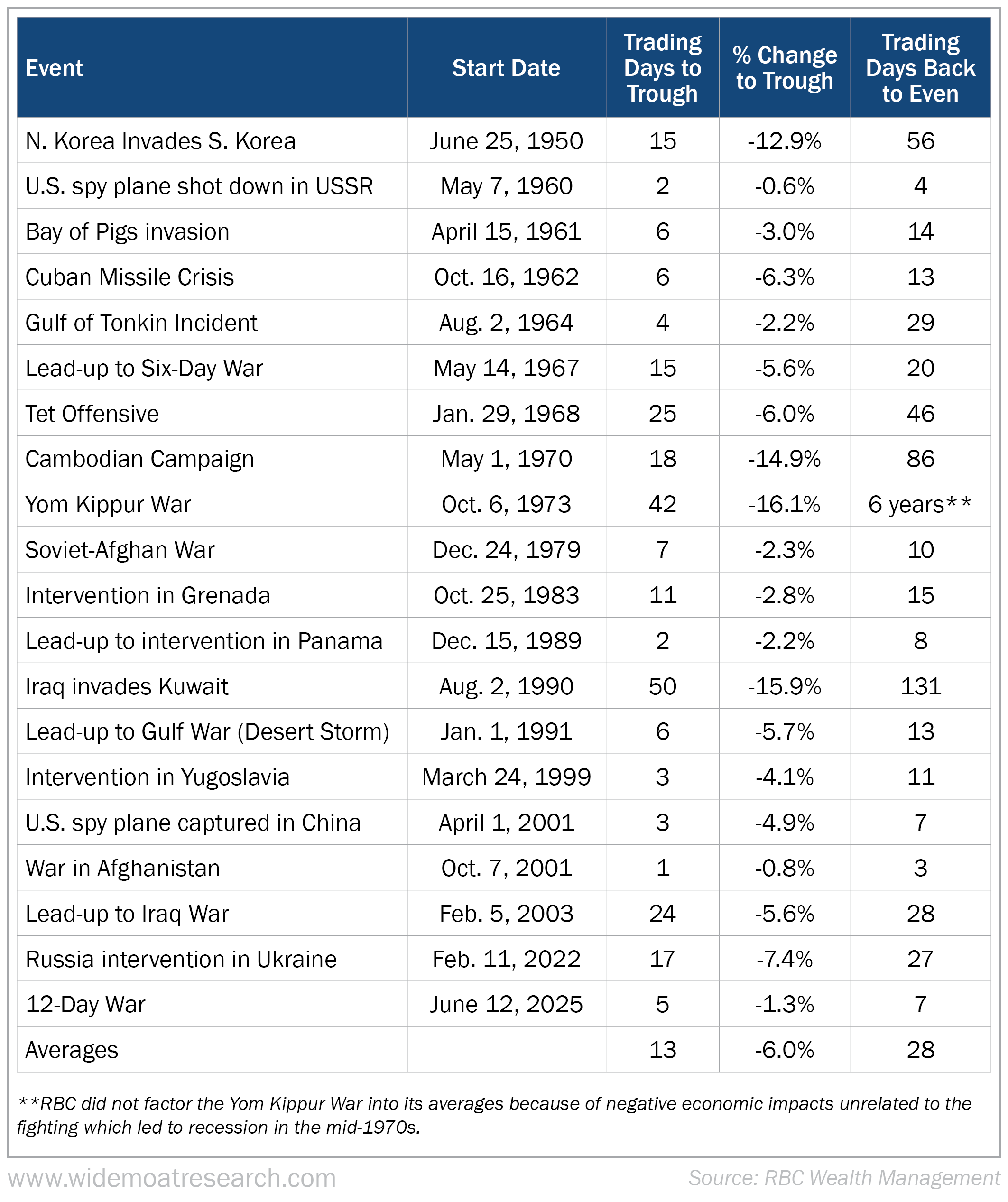
As you can see, the average sell-off during these military conflicts was just -6%. Honestly, I thought it would have been more. I suspect most people would have too. Maybe that’s why John is running for the hills right now.
But -6%?
That’s nothing to lose sleep over.
It’s well below the average annual pullback that the S&P 500 has experienced during the past 45 years.
Here’s a chart from Raymond James. It shows the average annual intra-year pullback in the S&P 500 since 1980 has been roughly 14%. And yet, as you can see, during the vast majority of these years, the broad market’s performance was still positive (often, posting double-digit growth), in spite of these short-term dips.
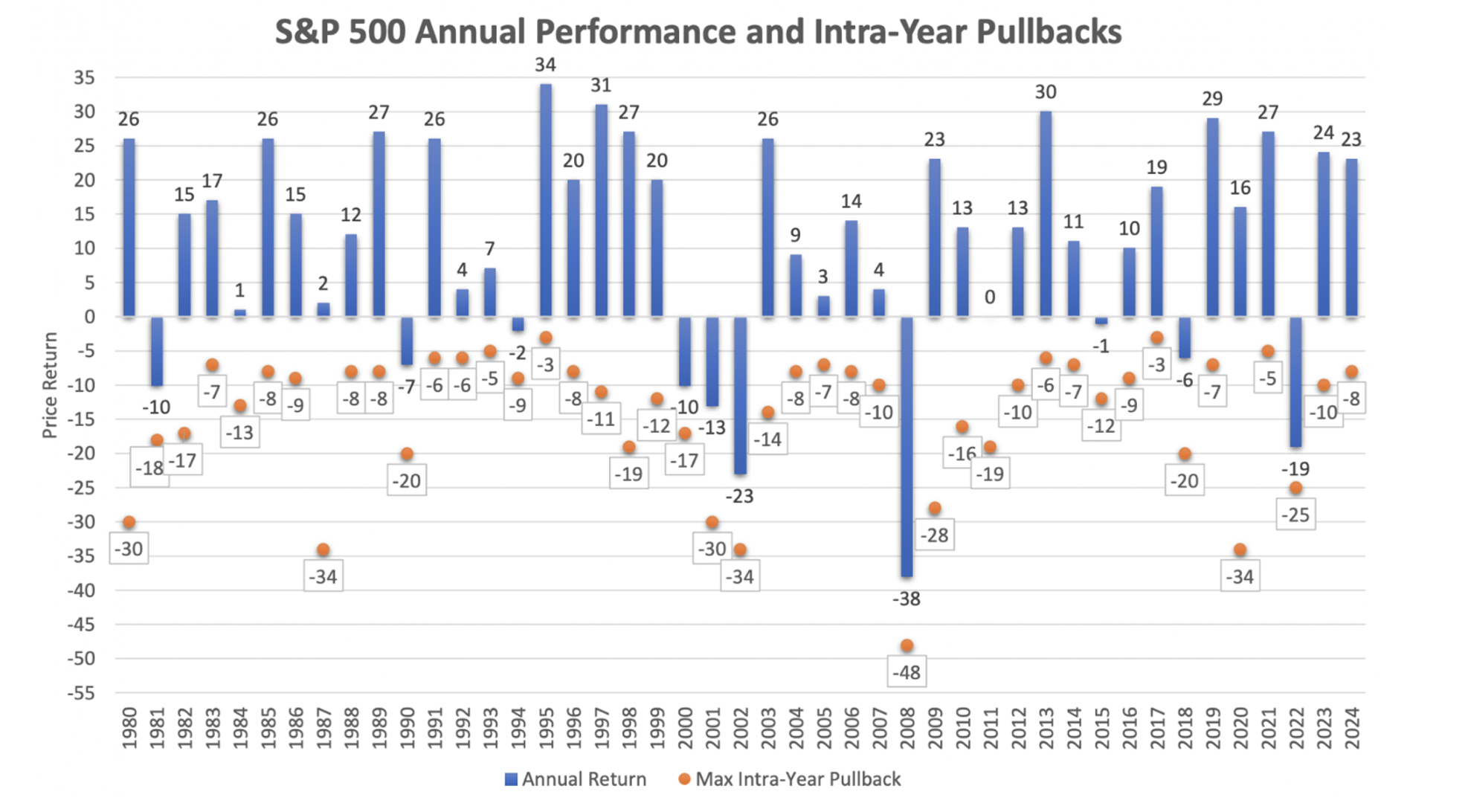
Source: Raymond James Wealth Management
I was also surprised to see how quickly the stock market bounced back from news of war. Outside of a few events, the market bounced back, on average, in less than a month.
Bottom line: War-related stock market troughs occur very early, and it doesn’t take long for the S&P 500 to make new highs, even during prolonged wars.
Speaking with John, it became clear he thought this conflict would get worse. You don’t have to look hard to find headlines related to nuclear bombs or World War III. It doesn’t get scarier than that.
So, when preparing for this essay, I looked back at how the S&P 500 performed during the most apt comparison to that terrible scenario: World War II.
The sell-off that the S&P 500 experienced when WWII began was much more severe than the -6% average discussed above. But just like in more recent conflicts, the market bounced back relatively early in the fighting (after the Battle of Midway in 1942). The market was much higher in 1945 than 1941, the year America officially joined the war.
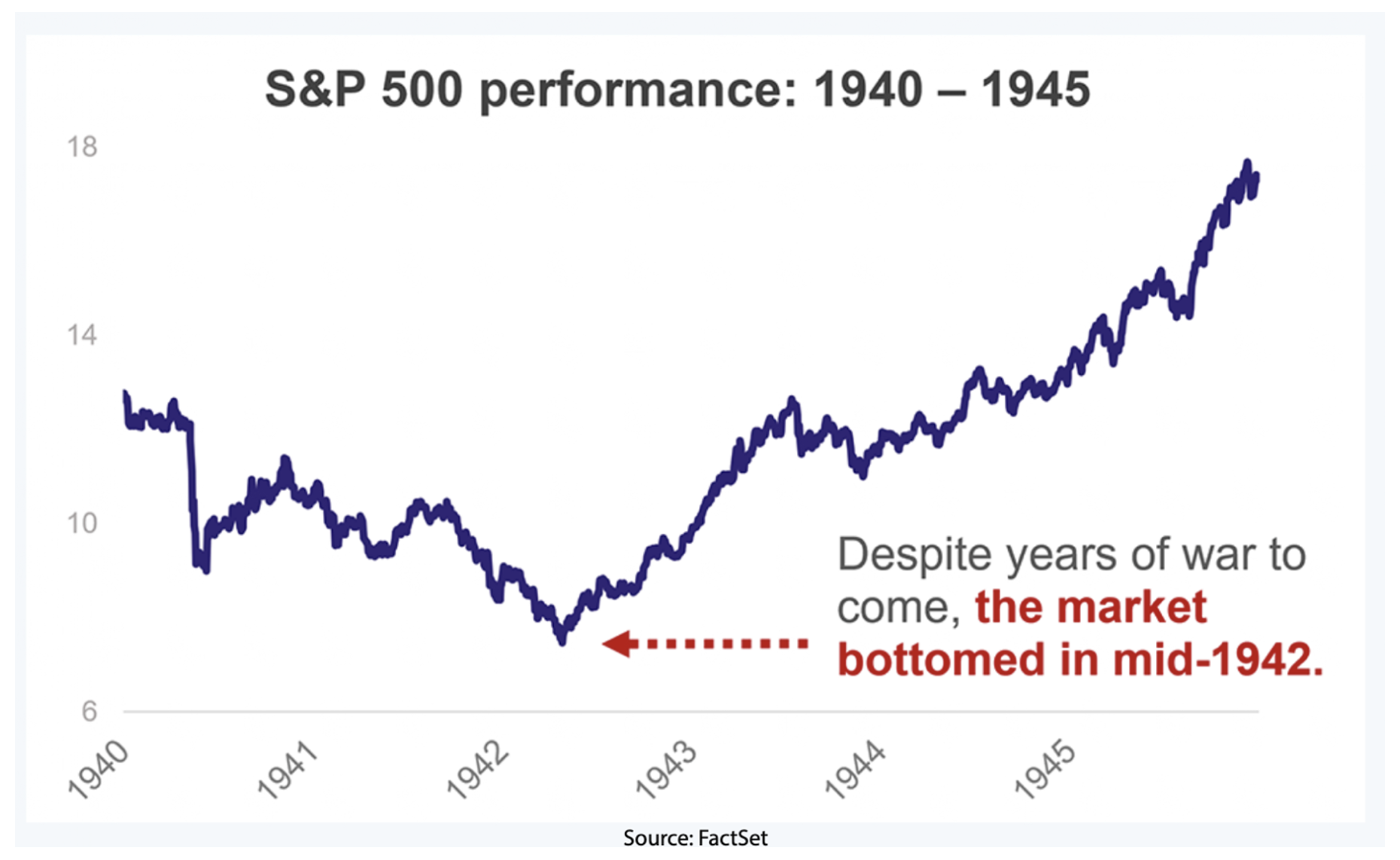
Source: Baird Private Wealth Management
Keep Calm and Carry On
Speaking of the Second World War, the British had a motto during that conflict: Keep calm and carry on.
That was good advice then. It still is today.
It’s in investors’ best interest to hold the line, stick to their long-term plans, and avoid the temptation to do something rash.
In the past, I’ve written about why “doing nothing” during fearful times is the best course of action for long-term investors. The data is very clear about the importance of staying invested, rather than trying to time the market in the short term. Here’s an essay I wrote about a year ago which shows how detrimental trying to time the market can be to your portfolio.
All that data holds true today. Furthermore, it’s backed up by historical data specifically related to wars/armed conflicts.
Time and time again, we see that market timing is a fool’s errand. Despite fears of a prolonged war in the Middle East, investors who sell today will likely regret it.
I wouldn’t be surprised to get a new text from John in a few months: “Hey, which stocks should I buy?”
Regards,
Nick Ward
Analyst, Wide Moat Research
|