It’s an average day, and you are on your phone scrolling through stock prices. They seem to move up and down randomly, and you are checking which stocks did best and worst in your portfolio.
If you are like most investors, there is a nagging feeling that just won’t go away: Is there more to the story? Is there a whole system driving stocks that is kept hidden from regular investors?
It’s not a conspiracy theory.
There is a deeper layer to the markets running behind the scenes – like the code in The Matrix. In today’s edition of The Wide Moat Daily, I’m going to do more than just reveal what it is.
I’ll decode it and show you some truly incredible numbers.
The Hidden Layer
The “operating system” of the stock market is options. Understanding how they work can give you an edge few investors have – even against sophisticated financial professionals. And no, you don’t need to trade options yourself. I do (a lot), but the truths the option market teaches are available to everyone willing to learn.
One of the reasons so few people understand options is they seem like a machine – rather than a human – designed them. That makes it hard to understand without a good teacher. This article isn’t designed to teach you everything there is to know about options. But I will use real-time options data to drive home one of the most important lessons.
Battle of the Titans
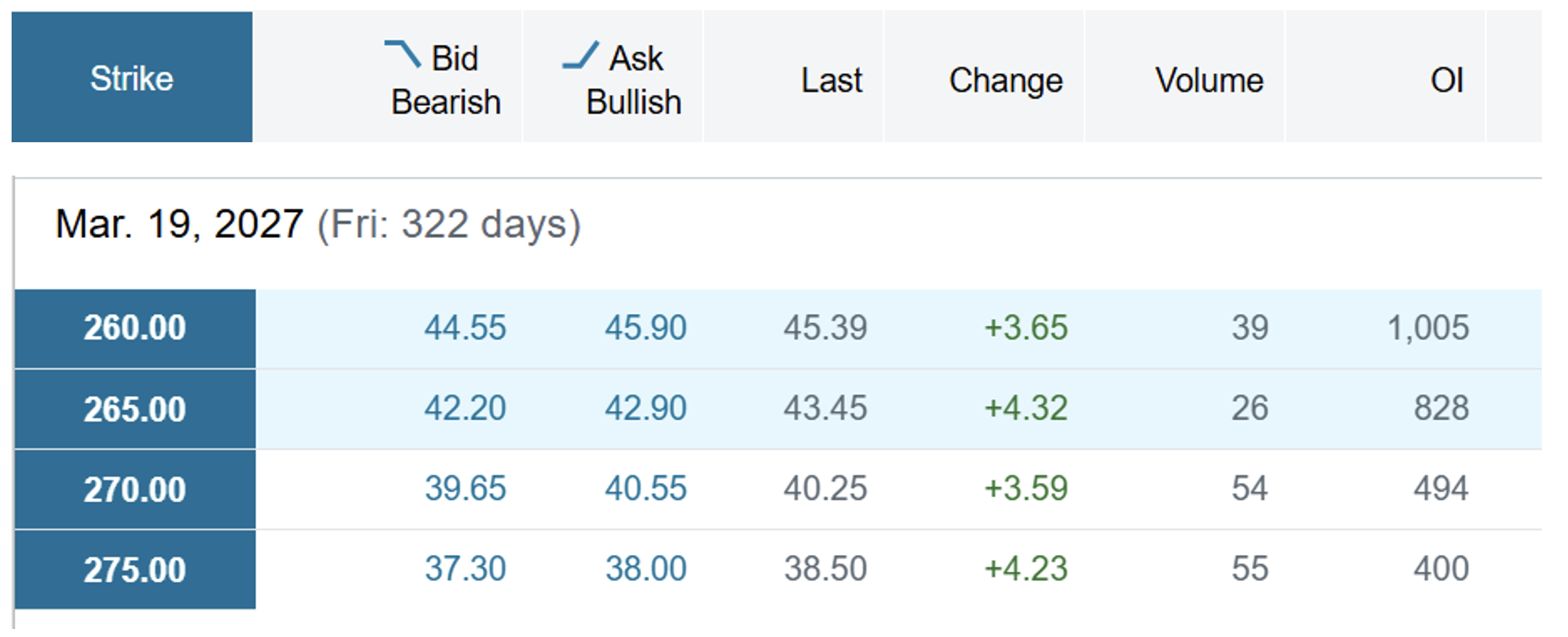
Let’s start with Amazon (AMZN) since it’s a company everyone knows. It’s a $2.85 trillion market capitalization juggernaut that just released earnings. The earnings were bullish, with Amazon Web Services (“AWS”) backlog reaching $364 billion. That pushed the stock price up to $270 per share. Now, let’s see what the options market can tell us about the future.
Source: Schwab
Don’t worry, I’ll translate the “code.” This is data related to call options. There are also put options and combinations of put and call options, but we’ll set that aside.
A call option is a bullish bet on a stock. It’s like buying stock in many ways except for two factors. First, the trade has a defined lifetime – in this case, the contract expires on March 19, 2027, or in 322 days. Second, the call option expires worthless if the stock price is below the strike price. It’s a “leveraged” bet in the sense that the upside is greater than owning common stock if it rises, but the whole investment (what you paid for the call option) is lost if the trade doesn’t work out.
Let’s focus on the $270 strike since that’s closest to Amazon’s current share price, which trades around $269 as I write.
The option market prices this call option at about $40 per share or $4,000 per contract (each contract represents 100 shares of common stock).
For the buyer of this call option to make any profit, Amazon common stock must be trading above $320 by March 2027.That’s because the trader needs to overcome the “hurdle” – the cost – of the $4,000 they paid to acquire the option.
There is a scenario where Amazon trades above the strike price of $270 on that date, but it’s not enough to overcome the premium paid. In that case, it’s a partial loss. But if AMZN is below the strike price on the expiration date, the buyer of the call option loses 100% of their investment.
Here’s the bottom line: The fact that investors are purchasing this contract tells us a 15% gain on Amazon stock over the next year or so is in the cards. And depending on the volume for this contract, we can get an idea of the market’s conviction for that outcome.
Remember, unlike stocks, it is the experienced (and well-capitalized) investors who tend to trade options. Most work at hedge funds or for other large institutional investors with the best risk management software and research in the world.
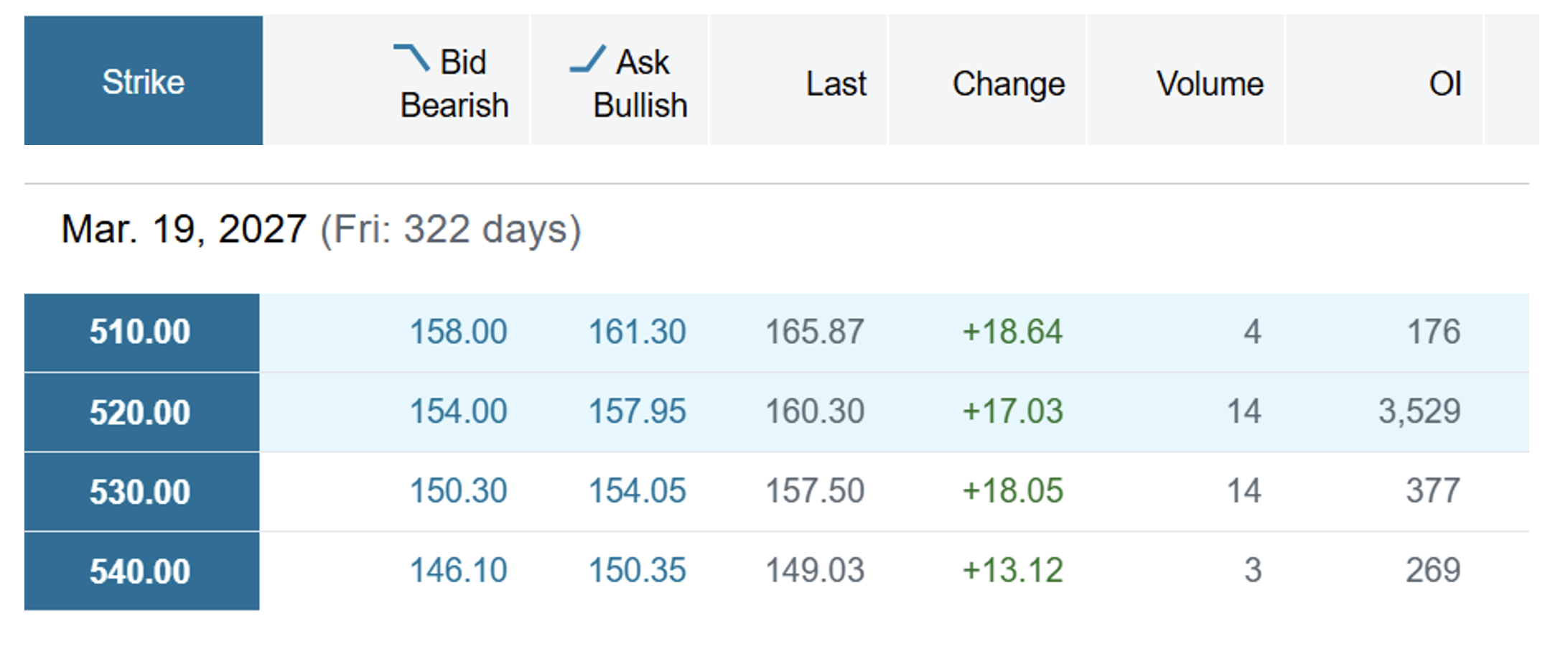
Now, let’s see what the options market tells us about another tech superstar: Micron Technology (MU). Micron designs and manufactures memory and storage chips. They sell these chips to companies building services, computers, smartphones, and increasingly AI systems. You’d assume that the options market would treat Micron and Amazon similarly, but let’s see if that’s the case.
Source: Schwab
This is the same setup but with a Micron call option expiring on March 19, 2027. With each contract priced at about $160 a share or $16,000 in total, the breakeven share price is $687. The options market is pricing in a minimum share price gain of 31% – and in just about 10.5 months.
It’s invisible to most investors, but the “smart” money doesn’t just believe in Micron – it is betting on double the gains for Micron compared to Amazon over the same period.
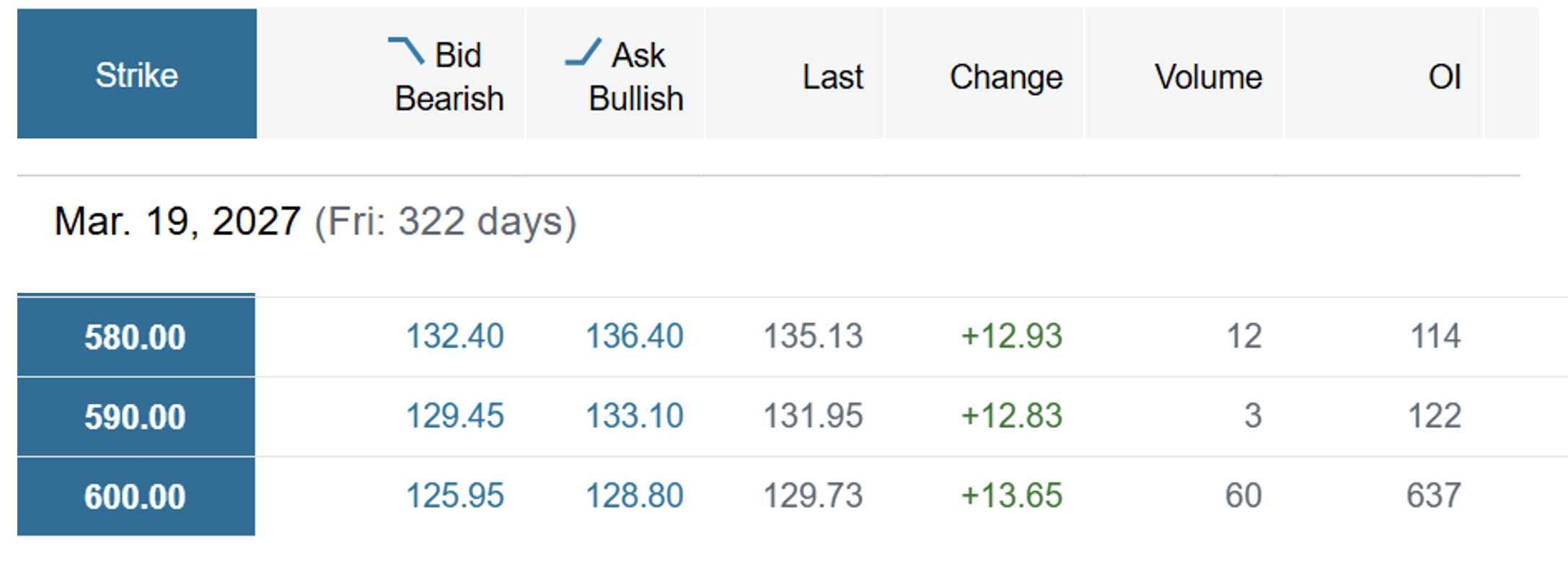
The options market is extremely flexible, so you don’t have to buy call options with today’s share price as the base. Here’s where the options market goes to “hyper bullish.”
Source: Schwab
Focus on the $600 contract shown above. We are moving the strike price from $530 (the current share price) all the way up to $600. But the price of the bullish call option only drops slightly to $129 per share or $12,900.
The key takeaway is the breakeven for this contract is $729 and it must occur before March 19, 2027. The option contract is pricing in more than 39% gains in Micron’s stock price in the next 10.5 months.
Remember, the buyer of the call option only breaks even at that price. They must anticipate a much higher stock price for this expensive bet to make any sense.
Conclusion
I deciphered a lot of “Matrix code” at you in this edition, so thank you for sticking with me. This knowledge is too important to keep hidden. It revealed how different the market’s expectations are even between two leading technology companies.
Imagine what the options market can tell us across sectors and how expectations differ between the best and worst players in an industry. The options market is far from perfect when it comes to predicting stock prices. But it does give you perfect information about what the real market movers expect.
Even if options seem too complicated or risky for you to trade, they’re still incredibly useful. It tells you what the Matrix is predicting about the future – and with serious money on the line. These aren’t worthless Wall Street analyst estimates from people with no skin in the game. These are elite market players with billions on the line tied to highly specific bets. And all the information is there for those who know how to read the code.
Regards,
Stephen Hester
Chief analyst, Wide Moat Research
|